
Your cart
There are no more items in your cart
Key takeaways
- A 2026 discovery: Vanilla pacifica was officially described in June 2026 following a true herbarium investigation.
- Extreme rarity: only six documented living individuals, in three isolated locations in Colombia and Ecuador.
- Its cradle, the Chocó: one of the rainiest and most biodiverse regions on the planet, on the Pacific coast.
- Beware of homonyms: the "Vanilla pacifica" found in perfumery is a cosmetic brand with no botanical link to the wild orchid.
- A conservation challenge: classified as critically endangered, it is a precious genetic reservoir for the future of vanilla.
Not all vanillas can be tasted. Some are meant to be told as a story. Pacifica vanilla belongs to this second category—orchids so rare that no food lover will likely ever taste them, yet their very existence is a marvel. Six living individuals known in the world, a scientific description in 2026, an investigation worthy of a detective novel spanning herbariums globally: here is the story of the ghost orchid of the Chocó. And I must warn you right away, in all honesty, there is a naming trap that many fall into.
What is pacifica vanilla?
Pacifica vanilla, under its scientific name Vanilla pacifica, is a climbing hemiepiphytic orchid capable of growing six to twelve meters up host trees. It is a neotropical species, a cousin of Bourbon vanilla, but of unparalleled rarity. Unlike most vanillas known for centuries, this one has just entered the science books: it was formally described in June 2026 in the journal Discover Plants. It is, quite literally, a vanilla of our time.
Where does this ghost orchid grow?
Pacifica is endemic to the very humid tropical forests of the Pacific coast, in the municipality of Bahía Solano in the Colombian department of Chocó, and in northwestern Ecuador. This region, the Tumbes-Chocó-Magdalena hotspot, is one of the rainiest and most biodiverse places on the planet. The vine grows along riverbanks, from sea level up to nearly a thousand meters in altitude.
For generations, the indigenous and Afro-descendant communities of this coast have been harvesting wild pods from these vanilla vines for use in ceremonial rituals. They call the vine bejuquillo (the little vine), and its short, plump pods platanitos (little bananas), because of their highly distinctive shape.
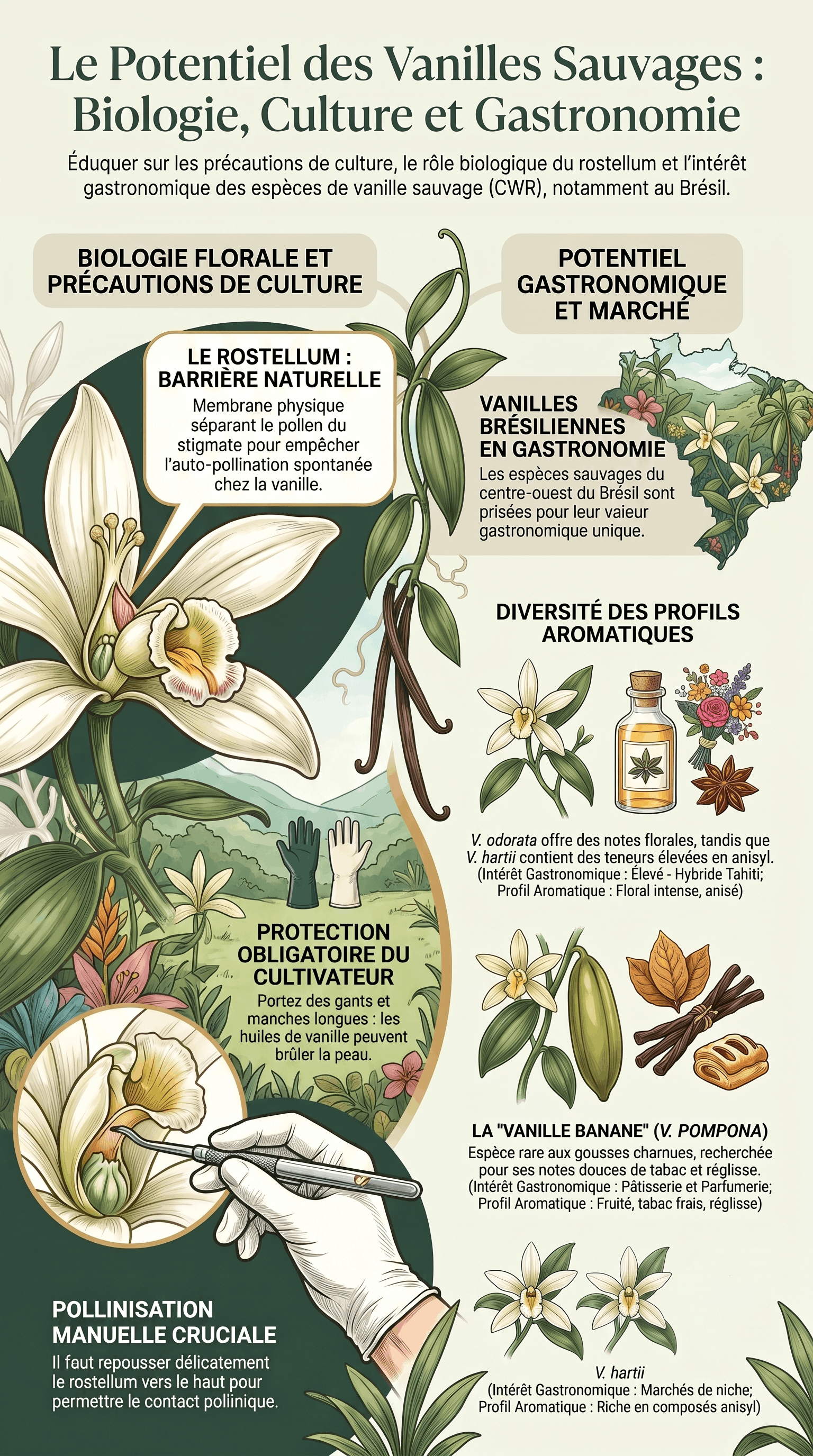
The unexplored wealth of wild vines, like those in the biogeographic Chocó.
How was it discovered in 2026?
This is the most beautiful part of the story, and it reads like an investigation. While methodically exploring over fifty herbariums worldwide in 2024, botanists Nicola S. Flanagan and Andres Navia-Samboni unearthed three forgotten specimens. The first was collected in Bahía Solano in 1989 and kept in a Colombian herbarium. Two others were collected in northwestern Ecuador in 1991 and stored in Quito. All three had been mistakenly filed under the name Vanilla planifolia, the common vanilla.
Upon re-examining them, the researchers realized they were not dealing with Bourbon, but with a never-before-described species. An anatomical detail gave it away: the flower's yellow labellum lacks the warty callus—the small rough outgrowth characteristic of planifolia. Thus, an orchid that had been sleeping in herbarium boxes for thirty-five years became, in 2026, a species in its own right.
Beware of homonyms: the orchid is not the perfume.
If you search for "Vanilla pacifica" on the internet, you will mostly find a vegan cosmetics brand, Pacifica Beauty, and its "Island Vanilla" or "Sugared Vanilla" perfumes. This is a mere coincidence of names. These fragrances are designed to evoke the floral notes of Tahitian vanilla and have no botanical connection to the wild orchid of the Chocó. Therefore, to be clear: the aromatic profile of the true wild Vanilla pacifica has never been analyzed or tasted, as it is not cultivated. I will therefore not describe a flavor that nobody knows.
Why is it critically endangered?
The numbers are staggering: to date, only six documented living individuals are known, spread across three highly fragmented geographic stations—one in Colombia and two in Ecuador. Six. At this scale, the loss of a single population would destroy an irreplaceable part of the species' genetic heritage. The vine flowers very sporadically in the jungle, making its natural reproduction extremely unpredictable. It is classified as critically endangered.
However, a glimmer of hope exists. Since 2015, the community project Vainilla Aroma Chocó, led by Afro-descendant community councils with NGO support, has been promoting in-situ conservation and the sustainable cultivation of indigenous vanillas in their collective territories. This is exactly the kind of initiative that gives these treasures a future.
Why does an invisible vanilla matter for the future?
One might think that an orchid so rare, and never cooked with, holds no interest for us. It is quite the opposite. Over 95% of the vanilla consumed worldwide comes from a single species, Vanilla planifolia, propagated by cloning. This creates an ultra-narrow genetic base, terribly vulnerable to diseases like fusarium wilt and to climate change. Wild vanillas like pacifica are living genetic libraries—a reservoir of resistance genes that science may one day draw upon to create more robust cultivated vanillas.
Interestingly, the roots of the wild pacifica harbor specific bacteria that help it assimilate phosphorus and defend itself against pathogens. These biological secrets could, tomorrow, help save the global vanilla industry. That is why protecting six vines lost in the Chocó forest is not a botanist's whim; it is an insurance policy for the future of vanilla.
Arnaud's Opinion
I will never sell you pacifica vanilla, and no one should pretend to do so: it only exists as six wild vines. But I wanted to dedicate an article to it, because it embodies everything I am passionate about in this profession. Behind the word vanilla lies an immense, fragile world, still full of discoveries, where new species are described as recently as 2026. To tell the story of pacifica is to remember that the true wealth of vanilla lies not in marketing, but in this biodiversity that must be protected before it disappears.
| Species | Status | Commercial Production | Distinctive Feature |
|---|---|---|---|
| Vanilla pacifica | Described in 2026, critically endangered | None (6 wild individuals) | "Platanito" pods, labellum without warty callus |
| Vanilla planifolia (Bourbon) | Cultivated globally | Over 95 % | The standard, very narrow genetic base |
| Vanilla x tahitensis (Tahiti) | Cultivated, rare | Approx. 0.25 % | Floral and anisic hybrid |
| Vanilla pompona (Vanillon) | Cultivated, confidential | Very low | Large pods, rich in coumarin |
1989Collection in Bahía Solano (Colombia) of a specimen mistakenly classified as Vanilla planifolia.
1991Two specimens collected in northwestern Ecuador, also misidentified.
2015Launch of the Vainilla Aroma Chocó community project for the conservation of local vanillas.
2024Re-examination of over fifty herbariums by Flanagan and Navia-Samboni, who unearth the forgotten specimens.
2026Official scientific description of Vanilla pacifica, a species new to science.
Explore vanillas of the world
From the ghost orchids of the Chocó to the great vanillas of our kitchens, discover the full diversity of the genus at our shop.
Discover our world vanillasFrequently Asked Questions
Can I buy and cook with pacifica vanilla?
No. The wild orchid Vanilla pacifica is not cultivated: only six living individuals are known. No pods are sold commercially, and its aromatic profile has never been analyzed.
What is the connection with the Pacifica perfume brand?
There is no botanical connection. It is a mere coincidence of names. The Pacifica Beauty brand sells floral-inspired perfumes evoking Tahitian vanilla, unrelated to the wild orchid of the Chocó.
Why is it so recent if the specimens date back to 1989?
Because they had been misidentified as common vanilla. It was only by re-examining herbariums in 2024 that botanists recognized a new species, officially describing it in 2026.
How do you distinguish pacifica from other vanillas?
By a detail in its flower: the yellow labellum does not have a warty callus, the rough outgrowth characteristic of Vanilla planifolia.
Why is its preservation important?
Like all wild vanillas, it forms a reservoir of resistance genes. Faced with a cloned and fragile commercial vanilla, these species could help create hardier crops against diseases and climate change.