Oolong Tea: buy quality blue-green tea

"I am Arnaud and I select this tea for you as an invitation to discover the richness and diversity of this traditional family. Each variety is carefully chosen to offer you an unforgettable tasting experience."

AS

I am Arnaud Sion

Founder of Comptoir de Toamasina — World flavors specialist

Passionate about tea since the age of 17, I traveled from Asia to Brazil to train as a tea specialist. Oolong is my favorite tea family. This passion guides each of my selections, focused on the search for rich, deep, and perfectly balanced flavors.

The Perfect Balance

Halfway between green tea and black tea. A unique partial fermentation that offers a perfect balance between invigorating freshness and aromatic depth.

Arnaud's Selection

The fruit of a constant search for excellence. Each cup is a work of art, shaped by time, climate, and the artisan's know-how.

Palette of Flavors

From floral and light notes to more full-bodied and woody flavors. An incredible diversity to satisfy all palates.

Comptoir de Toamasina is a reference shop specialized in blue-green tea. We offer an Oolong tea with subtle and refined flavors.

Also known as Wulong, this fascinating tea has partially oxidized leaves that reveal complex aromas and a taste that evolves majestically with each sip.

Whether you are looking for a comforting cup for the afternoon or an exotic tasting experience, our meticulous selection will meet your desires.

Oolong Tea

TOG
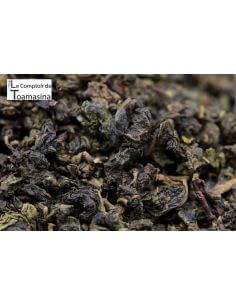
Oolong Tea means "black dragon" or "black snake", it is also called blue or blue-green tea in reference to the color of their infused leaves, they are fermented then this fermentation was interrupted during the process. Our Oolong is semi-fermented with a regular leaf. Power of Oolong tea: 8/10 Main notes: Fresh, slightly buttery flowers To savor: In the...
€10.90

Buy the best Oolong tea and travel to Asia

Discover the unique aroma of Comptoir de Toamasina's Oolong tea. I offer you the online sale of a tea with oriental beauty.

We invite you to explore this unique tea family, where each leaf tells a story of tradition and finesse. Our meticulous selection offers you the best of Oolong Tea, a range of semi-oxidized teas that captivate with their complex texture and aromatic bouquet of rich and deep flavors.

Our treasures of oriental beauty

Da Hong Pao (Big Red Robe): This is a jewel of our collection. Grown in the lands of Taiwan, this tea is a tribute to the goddess Guan Yin. Its controlled oxidation process reveals a wealth of flavors, perfectly balancing yin and yang.

Wu Long (Black Dragon): A tea that embodies elegance and power. Its leaves, from the noblest tea plants, offer an unforgettable sensory experience from the morning and gently extend into the early afternoon.

Every sip of our Grand Cru Oolong Tea is a celebration of perfection. Its velvety texture and intense fragrance transport you to a world of voluptuousness. We invite you to buy the best Grand Cru Oolong Tea at Comptoir de Toamasina, for a tasting that transcends excellence.

What is Oolong or blue-green tea?

Oolong tea is also called blue tea or blue-green tea by the Chinese, referring to its leaf which oscillates between blue and green when infused. It is a semi-fermented tea: oxidation has been deliberately interrupted during the process.

For Oolong tea, more mature leaves are generally used, which contain fewer tannins and caffeine. Our selection comes mainly from the Fujian province.

The manufacturing steps of excellence

1. Withering

The leaves are left to wither in the sun for a few hours, then placed back in the shade to initiate the leaf's moisture loss.

2. Fermentation (Sweating)

This is the crucial step. In a room at 25°C with 85-90% humidity, the leaves are stirred. This is where the aromas express themselves and deep flavors are sought. In China, fermentation is about 10 to 15% for light, vegetal, and woody flavors. To stop fermentation, sudden roasting is performed (as for green tea).

3. Rolling

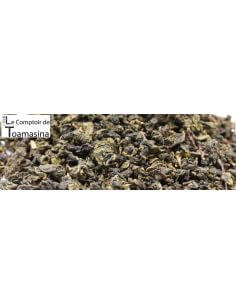
The tea master will perform a rolling process that will give the leaf its final shape (often crumpled or rolled into a pearl to release the plant's juices).

Etymology and legend of the Black Dragon

The term "Oolong" originates from Chinese (烏龍), literally meaning "black dragon". This designation evokes the dark color and twisted shape of the tea leaves, reminiscent of the silhouette of a majestic mythical dragon.

The Legend of Wu Liang

A popular legend features a Chinese tea producer named Wu Liang. After harvesting his leaves, he went hunting and forgot to roast them immediately. Upon his return, he discovered that the leaves, partially oxidized in the open air, had developed a unique floral taste. The name "Wu Liang" is said to have evolved over time to become "Wu Long" (Oolong), giving birth to this great family of tea.

The art of brewing Oolong

The art of brewing Oolong tea is a refined practice that requires precision. Water that is too cold would not extract the full aromatic palette. A shorter time preserves lightness, a longer time reveals depth.

Oolong tea has the rare particularity of being able to be infused several times (Gong Fu Cha method). Each successive infusion reveals new aromatic facets of the leaves.

Arnaud's brewing tips

  • Ideal dosage: About 5 grams for light Oolongs, and up to 7 grams for more oxidized ones (for about 250 ml of water).
  • Water temperature: It should be hot, close to 95°C (without boiling vigorously).
  • Brewing time: Between 5 and 7 minutes depending on the desired intensity.

Frequently asked questions

Where does the name Oolong come from?
From Chinese meaning "black dragon", referring to the color and shape of the leaves. A legend also attributes the name to the absent-minded producer Wu Liang.
Can Oolong tea be re-infused multiple times?
Yes, the traditional Gong Fu Cha method relies precisely on several short successive infusions. The rolled leaves gradually open, revealing new facets with each steep.
What dosage and temperature to brew an Oolong?
Count 5 to 7g of leaves for 250 ml of water. The water should be quite hot (about 95°C), and the infusion can last between 5 and 7 minutes according to your preferences.
Why is Oolong tea called blue-green tea?
Referring to the color of its leaves once infused, which oscillates between blue and green. This color is due to its partial fermentation (semi-oxidation), deliberately interrupted by the tea master.