Your cart
There are no more items in your cart
The Essentials
- Madagascar is the world's leading producer of vanilla and the primary producer of the Vanilla planifolia species, origin of the "Bourbon vanilla" designation.
- Without the discovery of a 12-year-old enslaved boy in 1841, Edmond Albius, vanilla would likely have remained a Mexican exclusive: his manual pollination technique made Malagasy cultivation possible.
- The heart of production lies in the SAVA region: Sambava, Antalaha, Vohemar, Andapa.
- Two primary grades: Gourmet, supple and plump, for fine pastry; Extraction, drier, for industrial extracts and flavorings.
- Nine months of maturation on the vine, followed by months of curing and aging: this long process is what sets ordinary vanilla apart from great vanilla.
Why I write this guide from the field, not from an office
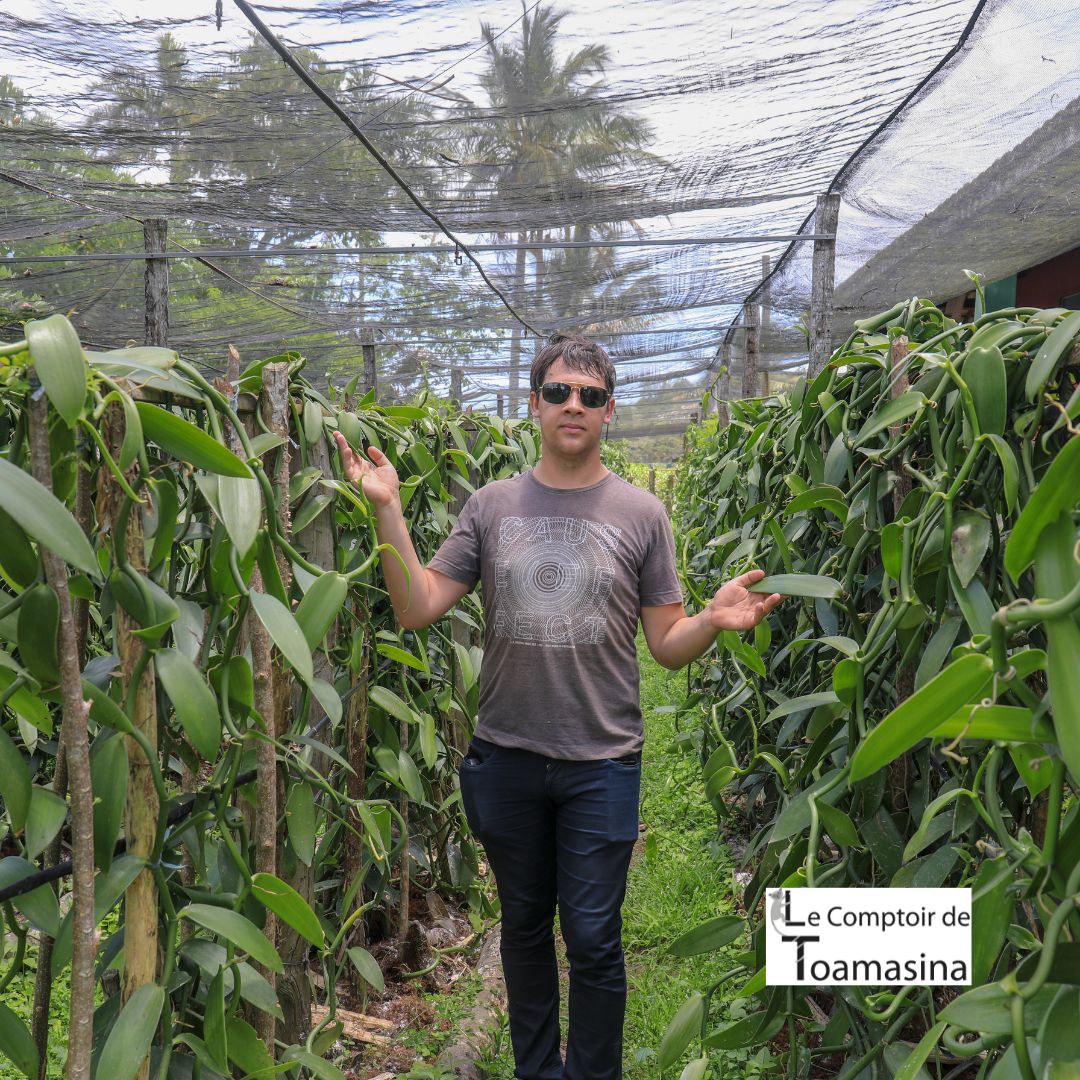
There are many guides about Madagascar vanilla online. Most are written by earnest enthusiasts who did their research. Mine is different for one simple reason: I don't retell what I read, I recount what I saw. In 2010, at age 21, a Toyota Hilux took me to see my very first vanilla plantation among a Malagasy farming family. I have returned almost every year since. This continuous hands-on training feeds every paragraph of this guide.
My core conviction from day one. Favoring one origin over another out of dogmatism makes no sense. Every vanilla holds its own aromatic power. Choosing a great vanilla involves terroir, climate, and above all, the painstaking work of the men and women who bring it to life.
The complete history: from Mexico to Madagascar, through colonial tragedy
To truly understand Madagascar vanilla, we must travel back much further than the Red Island itself. This story begins with the Totonac people in present-day Veracruz, Mexico—the only people on Earth to have domesticated and cultivated vanilla for nearly three centuries before the arrival of Europeans. The Aztecs, who conquered their territory, turned it into a precious tribute, blended with cocoa in a beverage reserved for the elite.
The orchid Vanilla planifolia arrived in Europe in the early 1520s, brought by Hernán Cortés alongside chocolate. Yet for over three centuries, every attempt to cultivate it outside Mexico failed systematically. The vines grew, even blossomed occasionally—but never yielded pods. The mystery seemed unsolvable.
The secret only Mexico possessed
The reason for this failure remained hidden for centuries: the vanilla flower can only be fertilized naturally by a single species of bee, endemic to Mexico, the Melipona. Without this tiny insect, the flower remains sterile wherever it is planted around the globe. By uprooting the plant from its native ecosystem, European colonists had inadvertently rendered it infertile.
In 1837, Belgian botanist Charles Morren succeeded in performing the very first artificial pollination of a vanilla flower in Belgium. A scientific milestone—yet one that produced no usable pods: the Belgian climate was simply unsuited for this tropical orchid. Frenchman Neumann attempted the same in mainland France with equal lack of success. Four more years and a whole new continent were needed for a practical, repeatable solution to finally emerge.
The discovery of Edmond Albius, 1841
It was on Bourbon Island—present-day Réunion—that a 12-year-old enslaved boy, Edmond Albius, solved what had stumped Europe's top botanists. Using a simple bevelled stick of wood, he discovered the exact gesture to fertilize a vanilla flower by hand: delicately lifting the membrane—the rostellum—that naturally separates the male and female organs of the flower (the anther and stigma), then pressing both together so pollen fertilizes the pistil.
This gesture, known today as the "Albius method," literally reshaped the global destiny of vanilla. It shattered the centuries-old Mexican monopoly and enabled large-scale vanilla farming across French colonies in the Indian Ocean. It is this exact method, virtually unchanged, that SAVA growers reproduce flower by flower every single morning of the blooming season.
Yet Edmond Albius's story is also a tragedy. His discovery generated colossal fortunes for Bourbon Island settlers. But the system that enslaved him granted him no share of that wealth—he even lived to see botanists attempt to claim credit for his invention. It is a story I always share with those discovering vanilla for the first time: behind the word "Bourbon" stands a 12-year-old child to whom we owe everything, and who received almost nothing in return.
From Bourbon Island to Madagascar
Albius's technique spread first across Réunion, which became a major production hub over the following decades—producing nearly 1,200 metric tons per year by the 1930s, a volume then comparable to Madagascar's. It was only in 1880 that French colonists introduced vanilla to the Red Island. Thanks to its climate and vast coastal areas ideal for cultivation, Madagascar gradually surpassed Réunion throughout the 20th century to become the world's leading producer. It was not until 1964 that the official Bourbon AOC designation was established, legally cementing this historical tie between Bourbon Island and Indian Ocean vanillas.
Why do we call it "Bourbon vanilla"?
The Bourbon designation is not a mere marketing tagline: it is a historical geographic designation. It satisfies two precise criteria: the species must be Vanilla planifolia, and the pod must originate from the southwestern Indian Ocean—Madagascar, Réunion, Comoros, Mauritius, or Seychelles. Another species, even if grown within this same region, cannot legally be called Bourbon vanilla. Madagascar Bourbon vanilla is today, by far, its most famous representative—the very one through which I discovered this spice in 2010.
Before 16th centuryVanilla domestication by the Totonac people in Mexico, followed by Aztec tribute status.
Circa 1520Introduction of vanilla to Europe by Hernán Cortés, alongside chocolate.
1837First successful artificial pollination by Belgian botanist Charles Morren—without usable pod yields.
1841Edmond Albius, 12 years old, discovers the manual pollination method on Bourbon Island (Réunion).
1880Vanilla introduced to Madagascar by French colonists.
1930sRéunion produces ~1,200 tons annually, a volume comparable to Madagascar at the time.
1964Official creation of the Bourbon AOC appellation.
TodayMadagascar is the world's top vanilla producer, with the SAVA region as its historical quality epicenter.
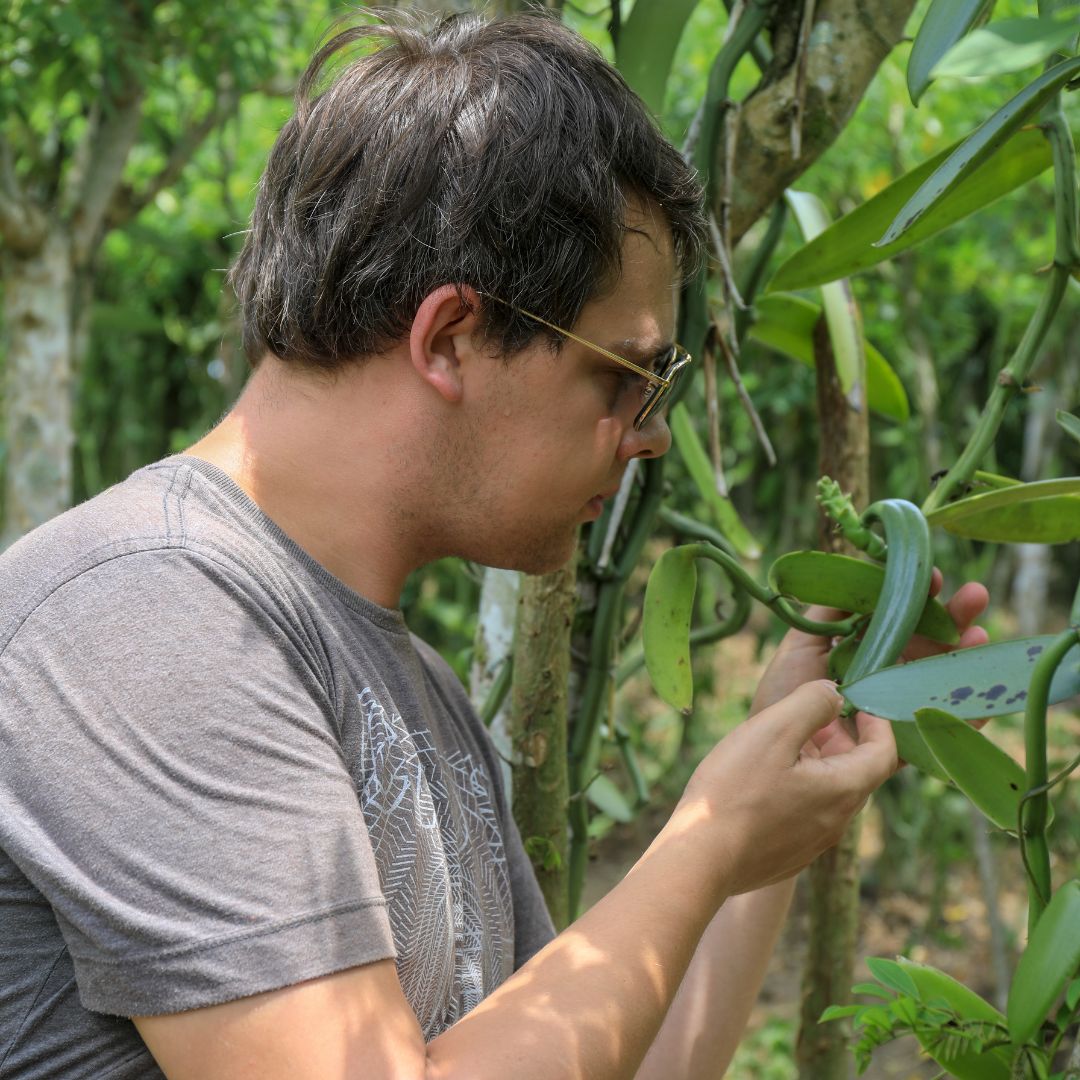
Arnaud Sion inspecting vanilla vines in the heart of a SAVA plantation.
Botany: what a vanilla pod really is
Vanilla is not a seed, a root, or a bark: it is the fruit of an orchid. Vanilla planifolia is a tropical climbing vine with thick, fleshy stems that winds around a support tree seeking canopy light. Its greenish-yellow flowers are fleeting: each blooms for only a single morning in its entire existence. If unpollinated during those few hours, it closes and falls, never producing fruit.
It is precisely this short morning window during bloom season that SAVA farmers must catch, flower by flower, across hundreds of plants. An experienced grower can hand-pollinate around 1,500 flowers a day during peak bloom—a relentless pace that accounts for much of this spice's cost.
Terroir: the SAVA region, where I learned the trade
The beating heart of Malagasy vanilla is located in northeastern Madagascar, in the SAVA region—an acronym for its four principal towns: Sambava, Antalaha, Vohemar, and Andapa. Antalaha is often called the vanilla capital of the world, and I have spent accumulated months of my life there over fifteen years. It is also from this region that "Toamasina-grade" vanilla comes, prized by chefs for its consistency and aromatic depth.
| Factor | What I observe on site |
|---|---|
| Humid tropical climate | Warm and rain-fed year-round, with a distinct dry season essential to trigger bloom |
| Volcanic soil | Rich and free-draining, nourishing the vine without waterlogging |
| Centuries of know-how | Passed down through generations, visible from delicate pollination to curing |
It is in this exact region that I work directly with growers. It is a sourcing model I detail in my article on direct producer vanilla.
Madagascar vanilla grades
Not all pods are created equal. Madagascar vanilla is categorized into grades based on quality, moisture level, and length.
| Grade | Appellation | Moisture | Length | Primary Use |
|---|---|---|---|---|
| A | Gourmet (TK) | ~30–35 % | ≥ 14 cm | Supple, plump pods: fine baking, tasting |
| B | Extraction | Lower | Variable | Drier pods: extracts, infusions, food industry |
Gourmet grade is the most sought-after for gastronomy: its pods are flexible, oily, and packed with caviar seeds. At Le Comptoir de Toamasina, I select exclusively Gourmet grade pods, chosen pod by pod.
The journey of a pod: from bloom to cured bean
Behind every pod lies painstaking labor—making vanilla one of the most demanding spices on Earth to produce. Here are the steps I have watched unfold year after year in SAVA plantations.
Step 1 · Hand PollinationThe vanilla flower opens for just one day. Lacking Melipona bees in Madagascar, every single bloom must be hand-pollinated using the Albius technique.
Step 2 · MaturationOnce pollinated, the pod grows and matures slowly on the vine for about 9 months. This is when aromatic potential develops.
Step 3 · ScaldingAfter harvest, odorless green pods are dipped in hot water at ~65 °C. This thermal shock stops plant life and triggers enzymatic reactions that create flavor.
Step 4 · SweatingPods are wrapped and kept warm in sweating boxes where they "perspire" and take on their characteristic dark brown hue.
Step 5 · DryingSun and shade drying alternates over several weeks until the precise target moisture content is reached.
Step 6 · Curing & AgingFinally, aging: pods rest for months inside controlled wooden trunks. Aromas concentrate and gain complexity—the phase where I am personally most uncompromising.
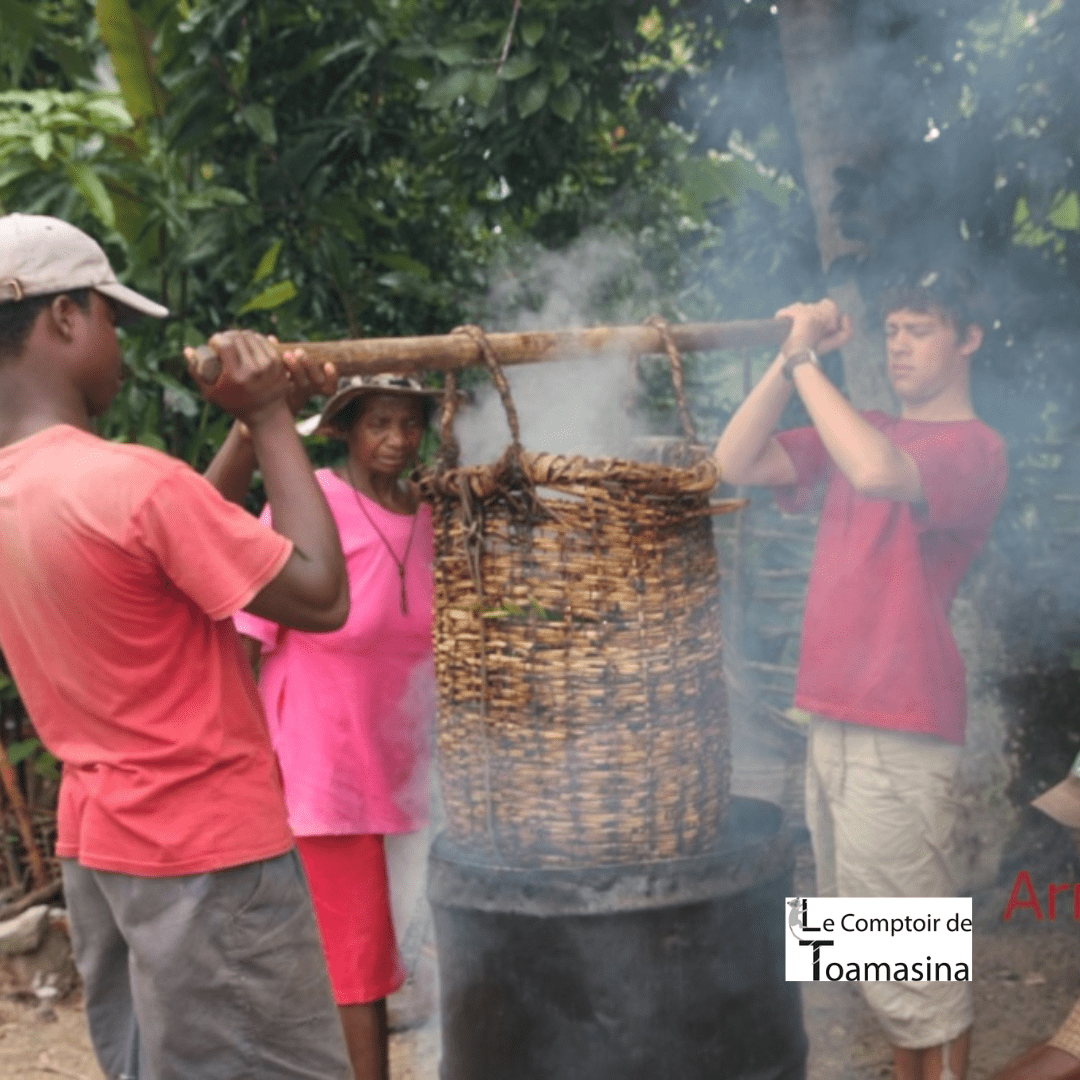
Traditional scalding at 65 °C: brief hot water immersion to halt plant growth.
Aromatic profile of Madagascar vanilla
The signature of Madagascar Bourbon vanilla lies in its warm, comforting palette: notes of caramel and brown sugar, accents of cocoa and chocolate, a buttery, milky roundness, and occasional hints of dried fruit and prune. This richness makes it the gold standard for classic desserts.
How to recognize a high-quality vanilla pod
| Criterion | What to check |
|---|---|
| Appearance | Dark brown, glossy, plump, and oily to the touch |
| Flexibility | Should tie around a finger without splitting or snapping |
| Length | 14 cm or longer for a Gourmet pod |
| Aroma | Powerful, complex, with no sour, fermented, or moldy smells |
Beware of a common misconception. A well-aged or "frosted" pod may feel firmer without being defective. Frosting consists of natural vanillin crystals rising to the surface: it signals exceptional aromatic concentration.
How to use and store Madagascar vanilla
Bourbon vanilla excels in custards, ice cream, caramel, and baked goods where its vanillin holds up remarkably under heat. For storage, use an airtight container kept away from light and heat—never in the refrigerator. I explain why widespread methods like freezing or storing in alcohol permanently ruin pods in my complete vanilla storage guide.
Why is Madagascar vanilla so expensive?
Vanilla is the world's second most expensive spice after saffron. High prices result from compound factors: painstaking cultivation (hand-pollination flower by flower), a long 9-month crop cycle plus months of curing, intensive manual labor at every turn, extreme climate vulnerability, and global demand that consistently outstrips supply from a handful of growing regions.
My commitment to Madagascar vanilla
At Le Comptoir de Toamasina, Madagascar vanilla is not just another item: it was the starting point of our entire adventure in 2010. My commitment rests on three pillars: direct sourcing with SAVA smallholders, hands-on personal selection where I inspect, smell, and approve every lot myself, and unhurried curing that never cuts corners on aging time.
▶
Watch my video walkthroughs, pod in hand, on Le Comptoir de Toamasina YouTube channel.
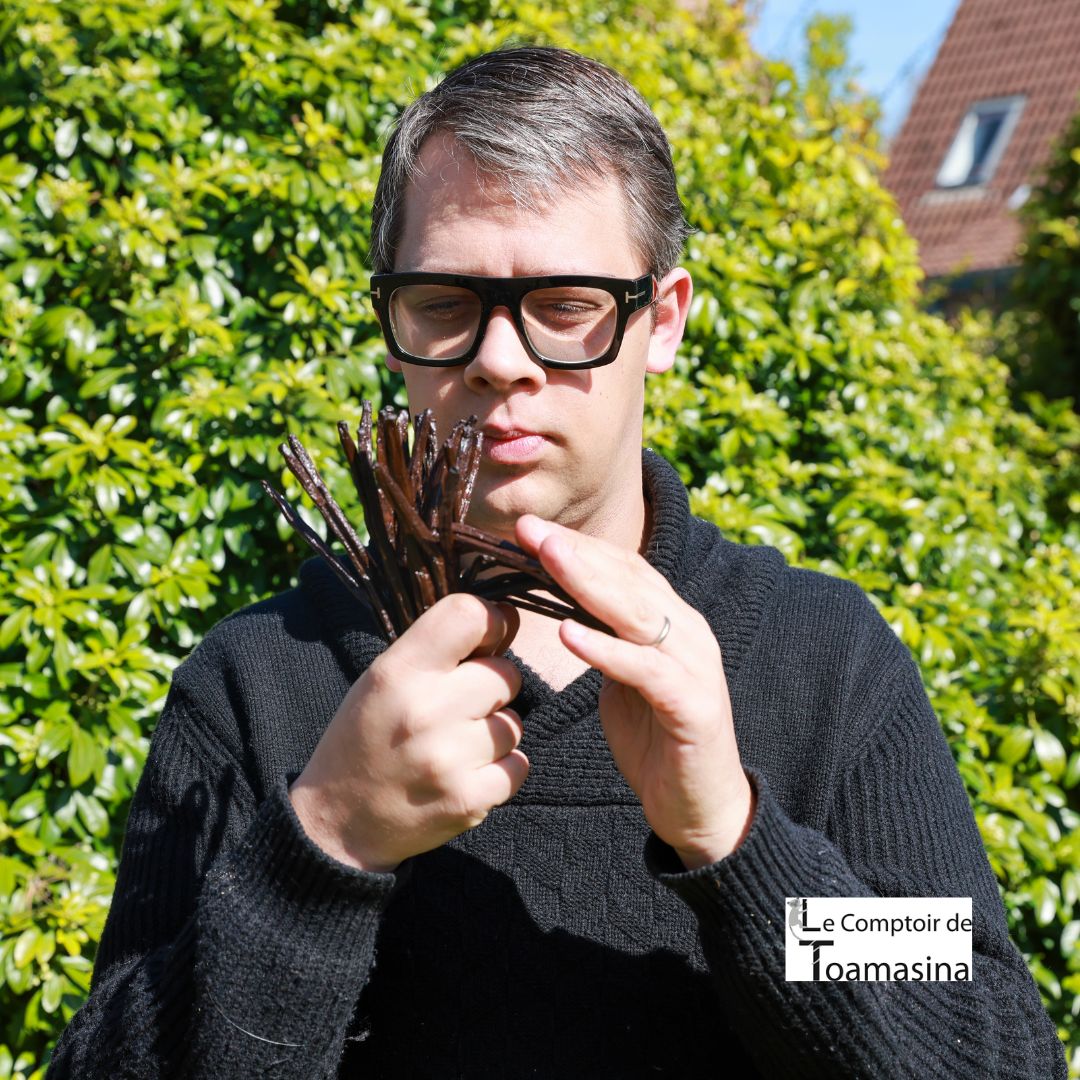
Arnaud Sion hand-selecting Gourmet Bourbon vanilla pods one by one.
Discover Our Madagascar Vanilla Selection
Explore our curations of Madagascar vanilla as well as our full range of world vanillas.
FAQ — Madagascar Vanilla
Why is Madagascar vanilla called the "queen of vanillas"?
Because it combines an exceptional terroir (SAVA region, volcanic soils, tropical climate) with centuries of hand pollination expertise inherited from Albius, delivering a rich, gourmand aromatic profile. Madagascar is also the world's primary producer.
Who invented manual vanilla pollination?
Edmond Albius, a 12-year-old enslaved boy on Bourbon Island (now Réunion), in 1841. His technique using a sliver of bamboo or wood to lift the rostellum remains virtually identical today in Madagascar.
Why did vanilla only grow in Mexico before 1841?
Because its natural pollination relied exclusively on a tiny stingless bee endemic to Mexico, the Melipona. Without it, vanilla flowers remained sterile anywhere else in the world.
What is the difference between Bourbon vanilla and Madagascar vanilla?
"Bourbon" is a regional appellation covering vanillas from the southwestern Indian Ocean (Madagascar, Réunion, Comoros, Mauritius, Seychelles). Madagascar vanilla is simply its most famous representative.
What is the difference between Grade A and Grade B vanilla?
Grade A (Gourmet) features moist, plump, supple pods (≥14 cm) ideal for fine baking. Grade B (Extraction) covers drier pods intended for extracts and industrial flavorings.
Why does Madagascar vanilla cost so much?
Due to labor-intensive hand pollination flower by flower, a 9-month crop cycle followed by months of curing, high climate vulnerability, and robust worldwide demand.