Your cart
There are no more items in your cart
C₈H₈O₃
Vanillin · 4-hydroxy-3-methoxybenzaldehyde · phenolic aldehyde family
Key Takeaways
- Vanillin is a natural aromatic aldehyde (C₈H₈O₃) responsible for the signature scent and flavor of vanilla.
- Green pods are odorless: vanillin is trapped as glucovanillin. Heat killing and curing activate beta-glucosidase enzymes that release the aromatic molecule.
- Scientific discovery: isolated in 1858 by French chemist Nicolas-Théodore Gobley and artificially synthesized in 1874 in Germany.
- Natural pod vs Synthetic: natural vanilla beans contain over 200 secondary aromatic compounds alongside vanillin.
- Vanilla Frost (Givre): pure vanillin naturally crystallizing on the surface of exceptionally rich pods.
Why Green Vanilla Pods Have Zero Aroma
One of the most surprising facts when visiting a vanilla plantation in Madagascar is that green vanilla pods do not smell like vanilla at all. Nature has locked the compound at a molecular level.
In the living plant, vanillin is bound to a sugar molecule, creating a compound called glucovanillin. In this glucosidic form, vanillin cannot evaporate or interact with human olfactory receptors.
The Role of Enzymes: Unlocking Fragrance
The traditional curing process—scalding, sweating, and sun-drying—triggers the enzymatic transformation. Enzymes called beta-glucosidases break the chemical bond between sugar and vanillin, freeing the fragrant molecule.
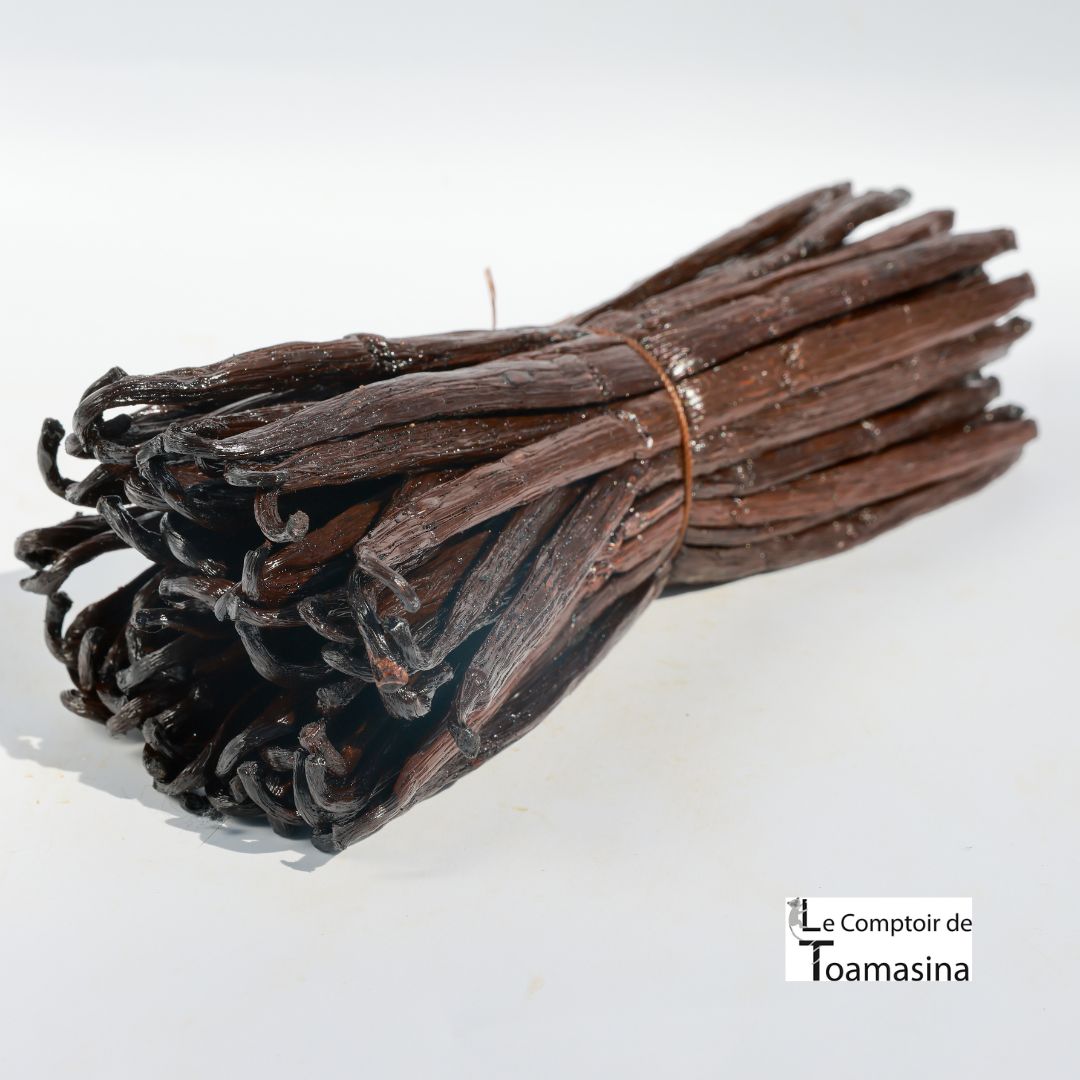
Gourmet vanilla beans cured according to traditional methods to maximize natural vanillin release.
Why Curing Quality Matters.
Poor curing leaves glucovanillin intact, permanently locking away flavor. The artisan's skill during sweating and drying is just as crucial as plant genetics.
Poor curing leaves glucovanillin intact, permanently locking away flavor. The artisan's skill during sweating and drying is just as crucial as plant genetics.
The History of Vanillin's Discovery
While indigenous Mesoamerican cultures cultivated vanilla long before Spanish contact, it was not until the 19th century that European science isolated the compound.
1858
French chemist Nicolas-Théodore Gobley isolates pure vanillin crystals by evaporating vanilla extract at low temperatures.
1874
German chemists Ferdinand Tiemann and Wilhelm Haarmann deduce vanillin's exact molecular structure and synthesize it artificially from coniferin (pine sap).
1876
Karl Reimer formulates a commercial synthesis of vanillin using guaiacol, a petrochemical byproduct still widely used in modern industry.
Natural Vanillin vs. Synthetic Vanillin
Synthetic vanillin possesses the exact chemical formula (C₈H₈O₃) as natural vanillin. Yet on the palate, the difference is immediate and striking.
| Criterion | Natural Vanillin (Whole Pod) | Synthetic Vanillin |
|---|---|---|
| Source | Natural glucovanillin liberated during bean curing | Petrochemical guaiacol or wood pulp lignin |
| Chemical Formula | C₈H₈O₃ | Identical: C₈H₈O₃ |
| Complementary Compounds | 200+ secondary aroma molecules (woody, floral, chocolate notes) | Isolated vanillin molecule only |
| Flavor Profile | Complex, evolving, warm, and lingering | One-dimensional, harsh, fades rapidly |
Vanillin Content Across Different Origins
Natural vanillin concentration varies based on species, terroir, and curing mastery.
| Origin & Species | Average Vanillin Content | Notes |
|---|---|---|
| Madagascar Vanilla (Gourmet) | 1.5% to 1.8% | Optimal balance. Levels above 2.0% are extremely rare without lab verification. |
| TK Grade Vanilla | 1.4% to 1.7% | Slightly lower moisture, excellent for extraction. |
| Wild Brazilian Vanilla (Bahiana) | Up to 4x higher | Wild endemic species with massive natural vanillin concentrations. |
Vanilla Frosting (Givre).
When vanillin content surpasses saturation limits inside high-grade pods, pure vanillin crystallizes on the surface as sparkling white needles. Known as "givre", this is the ultimate sign of exceptional quality.
When vanillin content surpasses saturation limits inside high-grade pods, pure vanillin crystallizes on the surface as sparkling white needles. Known as "givre", this is the ultimate sign of exceptional quality.
Golden Rule for Cooking
Vanillin is fat-soluble: it dissolves readily in lipids (whole milk, cream, butter, oil) and poorly in water. Always infuse vanilla in a lipid base to unlock its full aromatic potential!
▶
Watch our educational videos on Comptoir de Toamasina's YouTube channel.
Discover Our High-Vanillin Vanilla Beans
Hand-selected gourmet vanilla beans rich in natural vanillin and complex aromas.
FAQ — Vanillin Science
What is vanillin?
Vanillin is a naturally occurring phenolic aldehyde (C₈H₈O₃) that provides the primary flavor note in vanilla.
Why do green vanilla beans have no scent?
Vanillin is bound to sugar as odorless glucovanillin. Enzymatic curing breaks this chemical bond to release the aroma.
What is the difference between natural and imitation vanillin?
While the vanillin molecule itself is chemically identical, natural vanilla bean extract contains over 200 other aroma compounds that create a rich, multi-layered taste.
What is vanilla frost?
Vanilla frost refers to pure vanillin crystals forming naturally on the surface of exceptionally high-grade, well-cured vanilla beans.