
Your cart
There are no more items in your cart
C₈H₈O₃ — Melting Point: 82 °C to 83 °C
Pure vanillin is a white crystalline solid. It precipitates onto the surface when its concentration exceeds solubility limits inside the pod.
Key Takeaways
- Frosting (givre) is caused by supersaturation: vanillin concentration surpasses fluid solubility, causing pure vanillin to form solid crystals.
- Extremely high concentration threshold: frosting only occurs in exceptional beans exceeding ~2.3% pure vanillin content.
- Form depends on time: slow, multi-month curing yields delicate needle-like crystals. Sudden thermal shock (freezing) creates messy, ruined pods.
- Tahitian vanilla never frosts: its primary aroma compound is anisyl alcohol, not vanillin.
- Vanilla Pompona can develop a coumarin frost, offering bitter initial notes that develop into tobacco and tonka bean aromas.
Vanilla Frost vs. Mold: Clearing the Confusion
Mold is a living fungus: it looks fuzzy or cotton-like, appears in green, gray, or blue patches, and smells unpleasantly musty. Vanilla frost (givre) is an organic crystalline solid: it forms fine, shiny white needles that smell intensely of pure, sweet vanilla.
The Chemical Mechanism: Supersaturation at Work
In a fresh pod, vanillin is dissolved within pulp oils and moisture. Throughout months of traditional curing, water slowly evaporates while enzymatic activity generates more pure vanillin.
When the vanillin concentration exceeds the pod tissue's fluid capacity, the environment becomes supersaturated. The vanillin precipitates, migrating outward to form sparkling solid crystals on the skin.
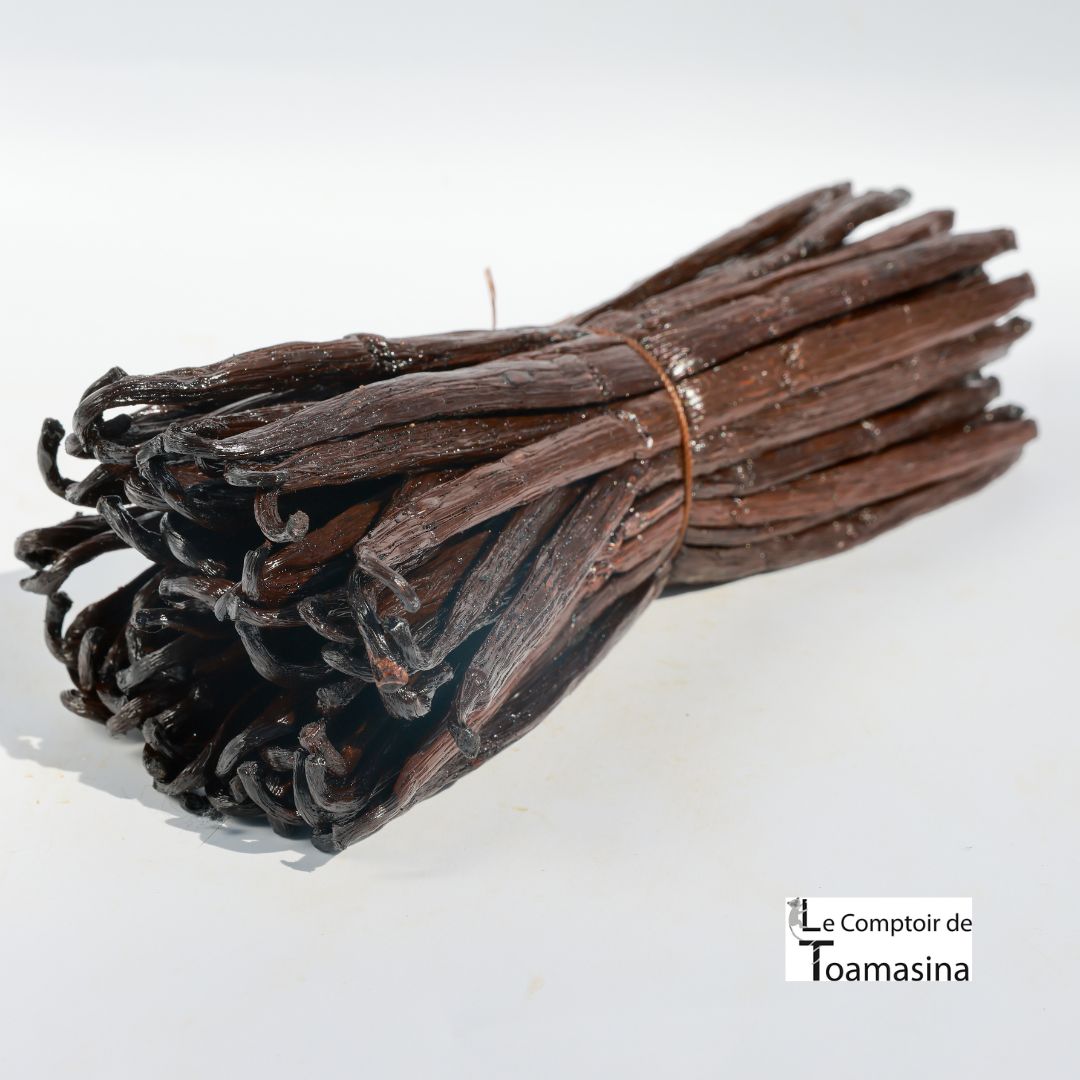
Extra gourmet Madagascar vanilla beans bursting with natural aromatic oils capable of frosting under ideal conditions.
The Threshold for Frosting.
Crystallization generally triggers above 2.3% pure vanillin. Standard commercial crops average 1.5% to 1.8%. Natural frosting is true proof of an extraordinary batch.
Crystallization generally triggers above 2.3% pure vanillin. Standard commercial crops average 1.5% to 1.8%. Natural frosting is true proof of an extraordinary batch.
Why Tahitian Vanilla Never Frosts
Vanilla tahitensis has a distinct molecular profile: its primary compounds are anisyl alcohol and methyl salicylate rather than vanillin. Its vanillin levels remain naturally too low to reach supersaturation. Any Tahitian bean displaying white crystals should be treated with suspicion!
The Case of Pompona Vanilla: Coumarin Frost
Vanilla pompona can sometimes crystallize, but the molecule responsible is often coumarin. Visually, it forms spiderweb-like threads over the pod. Taste-wise, it starts slightly bitter before revealing deep tobacco and tonka bean notes.
| Criterion | Vanillin Frost (Planifolia) | Coumarin Frost (Pompona) | Mold |
|---|---|---|---|
| Nature | Pure vanillin precipitation | Pure coumarin precipitation | Fungus (Living organism) |
| Appearance | Fine, shiny white needles | Flexible web-like filaments | Fuzzy, dull, patchy spots |
| Scent | Intense, sweet vanilla | Blond tobacco, tonka bean | Musty, damp basement smell |
| Significance | Exceptional flavor quality | Rare botanical characteristic | Spoiled product (discard) |
How to Verify Authentic Vanilla Frost
- Visual Inspection: Examine under direct light. Genuine frost glints and forms geometric needle structures.
- Scent Test: Smell the pod up close. The fragrance should be warm and sweet. Any musty note indicates mold.
- Gentle Heat Test: Under body heat from your palm, pure vanillin crystals soften gently without leaving water residue.
Why You Should Never Freeze Vanilla Beans.
Freezing damages plant cell walls, causing fat and sugar molecules to precipitate unevenly within hours. This is not natural vanillin frosting—it ruins the texture and flavor of your beans!
Freezing damages plant cell walls, causing fat and sugar molecules to precipitate unevenly within hours. This is not natural vanillin frosting—it ruins the texture and flavor of your beans!
Arnaud Sion's Advice
Always store vanilla beans in an airtight glass jar at room temperature (15 °C to 25 °C / 59 °F to 77 °F) away from light. In this stable environment, top-tier beans continue to preserve their natural vanillin.
▶
Watch botanical explanations on Comptoir de Toamasina's YouTube channel.
Discover Our Exceptional Vanilla Beans
Explore our selection of fresh, plump, high-vanillin gourmet vanilla pods.
FAQ — Vanilla Bean Crystallization
Is vanilla frost edible?
Yes, absolutely! It is 100% pure natural vanillin—the purest and most concentrated form of natural vanilla flavor.
Can all vanilla beans develop frost?
No, only exceptionally high-grade Vanilla Planifolia pods (exceeding ~2.3% vanillin content) can naturally develop frost.
Can you force vanilla frost artificially?
No. Freezing causes messy fat and sugar crystallization, which destroys bean texture rather than creating pure vanillin needles.
How do I tell vanilla frost from mold?
Frost sparkles in fine white needles and smells sweet. Mold looks dull or fuzzy, forms greenish/gray spots, and smells musty.