
Your cart
There are no more items in your cart
Key Takeaways
- Brazil is the world's sole producer of commercial guaraná (Paullinia cupana), grown across Amazonas, Bahia, and Mato Grosso.
- Agronomic Precision: Embrapa has developed high-yielding, high-caffeine, disease-resistant clonal cultivars.
- National Output: ~2,760 metric tons of dry seeds per year across 10,100 hectares.
- Major Threat: Anthracnose, capable of severe crop damage on non-resistant plants.
Why Guaraná Cultivation Captivated My Attention
Along with wild vanilla and açaí, guaraná is one of Brazil's botanical treasures. Visiting farms in Bahia revealed how technical this crop really is: modern guaraná farming relies on decades of selective breeding by Embrapa Amazônia Ocidental.
The Legend of Guaraná: The Eyes of Curumim
According to the Sateré-Mawé indigenous people, a beloved young child (the curumim) was killed by an evil spirit. To comfort the grieving tribe, the god Tupã instructed them to plant the child's eyes in the soil and water them with tears.
Why Is It Called "Warana"?
From that soil grew a plant whose ripe red fruit splits open to reveal black seeds resting on white arils, looking remarkably like human eyes. It was named Warana, meaning "resembling human eyes" in the Sateré-Mawé language.
From that soil grew a plant whose ripe red fruit splits open to reveal black seeds resting on white arils, looking remarkably like human eyes. It was named Warana, meaning "resembling human eyes" in the Sateré-Mawé language.
Botanical Background
Guaraná (Paullinia cupana Kunth var. sorbilis) belongs to the Sapindaceae family. It is a perennial tropical vine native to the Amazon rainforest, domesticated for the extraordinarily high caffeine content in its seeds.
Cultivars Developed by Embrapa
Commercial production relies heavily on elite clonal cultivars bred for disease resistance and high seed yield:
BRS Cereçaporanga
- Yield
- 1.30 kg of dry seeds per plant/year
- Productivity
- 520 kg/ha/year
- Resistance
- Resistant to trunk gall and bud hypertrophy
BRS Mundurucânia
- Yield
- 1.40 kg of dry seeds per plant/year
- Productivity
- 560 kg/ha/year average
- Resistance
- High resistance to anthracnose and trunk gall
BRS Luzeia
- Yield
- 1.60 kg of dry seeds per plant/year
- Productivity
- 640 to 1,000 kg/ha/year
- Caffeine Content
- High natural caffeine level
- Resistance
- High, stable resistance to anthracnose
BRS Andirá
- Yield
- 1.40 kg of dry seeds per plant/year
- Productivity
- 560 to 875 kg/ha/year
- Caffeine Content
- 4.2% — among the highest recorded
- Resistance
- Complete resistance to trunk gall
BRS Noçoquém (Recent Elite Selection)
- Genetics
- Bred from BRS Luzeia offspring evaluated over 10 years
- Yield
- 1.89 to 3.12 kg of dry seeds per plant/year
- Productivity
- 756 to 1,248 kg/ha/year
- Resistance
- High tolerance to anthracnose and floral bud hypertrophy
| Cultivar | Productivity (kg/ha/year) | Key Feature |
|---|---|---|
| BRS Cereçaporanga | 520 | Balanced disease resistance |
| BRS Mundurucânia | 560 – 875 | High anthracnose resistance |
| BRS Luzeia | 640 – 1,000 | High caffeine concentration |
| BRS Andirá | 560 – 875 | Caffeine record holder (4.2%) |
| BRS Noçoquém | 756 – 1,248 | Highest yielding modern clone |
The Importance of Field Sourcing
Being directly in the field is essential to ensure quality. The drying process defines the final active compounds and flavor profile of guaraná.
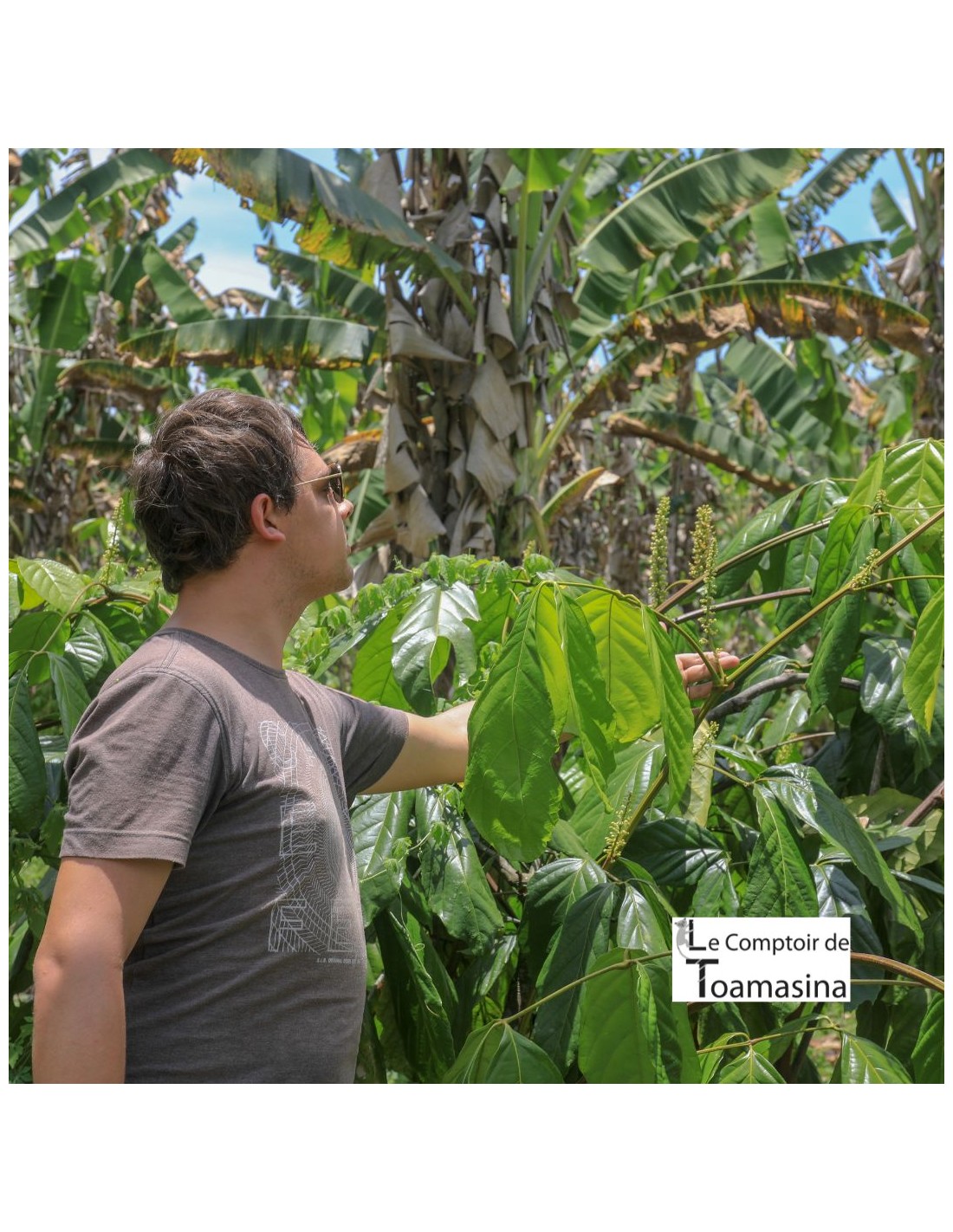
Arnaud Sion in the heart of a guaraná plantation in Brazil, working directly with local producers to ensure premium quality.
Seed Propagation and Nursery Protocol
Growing healthy guaraná seedlings requires strict management during the first 12 months:
- Stratification: Seeds are placed in wooden boxes filled with washed sand at 70% humidity to break dormancy.
- Germination (60–90 days): Once the radicle emerges, seeds are transplanted into nursery bags.
- Nursery Care: Kept under 50% shade cloth, with liquid fertilizer applied monthly from month 3 onwards.
- 12-Month Selection: Only vigorous 12-month-old seedlings are selected for field planting.
- Field Planting: Pits measuring 40 x 40 x 40 cm spaced at 5 x 5 meters.
Major Diseases
| Disease | Pathogen | Impact |
|---|---|---|
| Anthracnose | Colletotrichum guaranicola | Leaf scorching and major crop loss |
| Superbudding | Fusarium decemcellulare | Severe floral bud distortion |
| Trunk Gall | Bacterial/fungal complex | Structural swelling and vine weakening |
Guaranine & Tannins: Sustained Energy Release
Guaraná seeds contain caffeine (traditionally referred to as guaranine), along with theobromine and rich plant tannins. These natural tannins bind to the caffeine molecules, slowing their absorption into the bloodstream and delivering smooth, prolonged energy.
Field Insights from Bahia
Drying the harvested seeds (ramas) properly is critical. Damp seeds lose active compounds and develop stale off-flavors. That meticulous care during drying is why our guaraná powder delivers such exceptional purity.
▶
Watch our sourcing expeditions in Brazil on Comptoir de Toamasina's YouTube channel.
Discover Our Pure Guaraná Powder
Taste our premium Brazilian guaraná powder, hand-selected directly from Bahian farms for its freshness and rich natural caffeine profile.
FAQ — Guaraná Cultivation
Which country produces guaraná?
Brazil is the sole commercial producer of guaraná in the world (primarily grown in the Amazon region and Bahia).
What is guaranine?
It is chemically identical to caffeine. However, in guaraná, it is bound to natural tannins that slow its absorption for longer-lasting energy.
Which cultivar has the highest caffeine content?
The BRS Andirá cultivar developed by Embrapa leads with an average caffeine concentration of 4.2%.