
Your cart
There are no more items in your cart

When I walk through the plantations of Madagascar's east coast, between Fénérive and Sainte-Marie, there is a scent that catches you before you even see the trees. A warm, woody, almost medicinal fragrance floating in the air during drying. That is the scent of cloves. This small brown nail-shaped spice—known mainly for being studded into an onion or a holiday roast—hides one of the most potent spices in my selection. Potent in aroma, potent in history, and concentrated enough that a single clove can transform an entire dish. After fifteen years of bringing them back and tasting them at the shop, here is what I wish everyone knew to use and store them as they deserve.
What are cloves really?
They are often imagined as seeds or roots. In reality, a clove is an unopened flower bud. It is the flower of the clove tree, a tropical evergreen, picked just before it blooms, then sun-dried until it takes on a deep brown color and the small nail-like shape ("clou") that gave it its French name. The farmer's skill lies in the harvest timing: too early, the clove lacks body; too late, the flower opens and loses its aromatic concentration.
Madagascar is one of the world's great clove terroirs, and the east coast is its beating heart. I have seen entire families climb trees to pick the buds by hand, one by one, then spread them on mats along the roadsides. This patient labor explains part of the clove's value. Its fragrance comes from a naturally abundant aromatic compound, eugenol, which gives it its warm, woody, and slightly spicy signature, recognizable among a thousand.
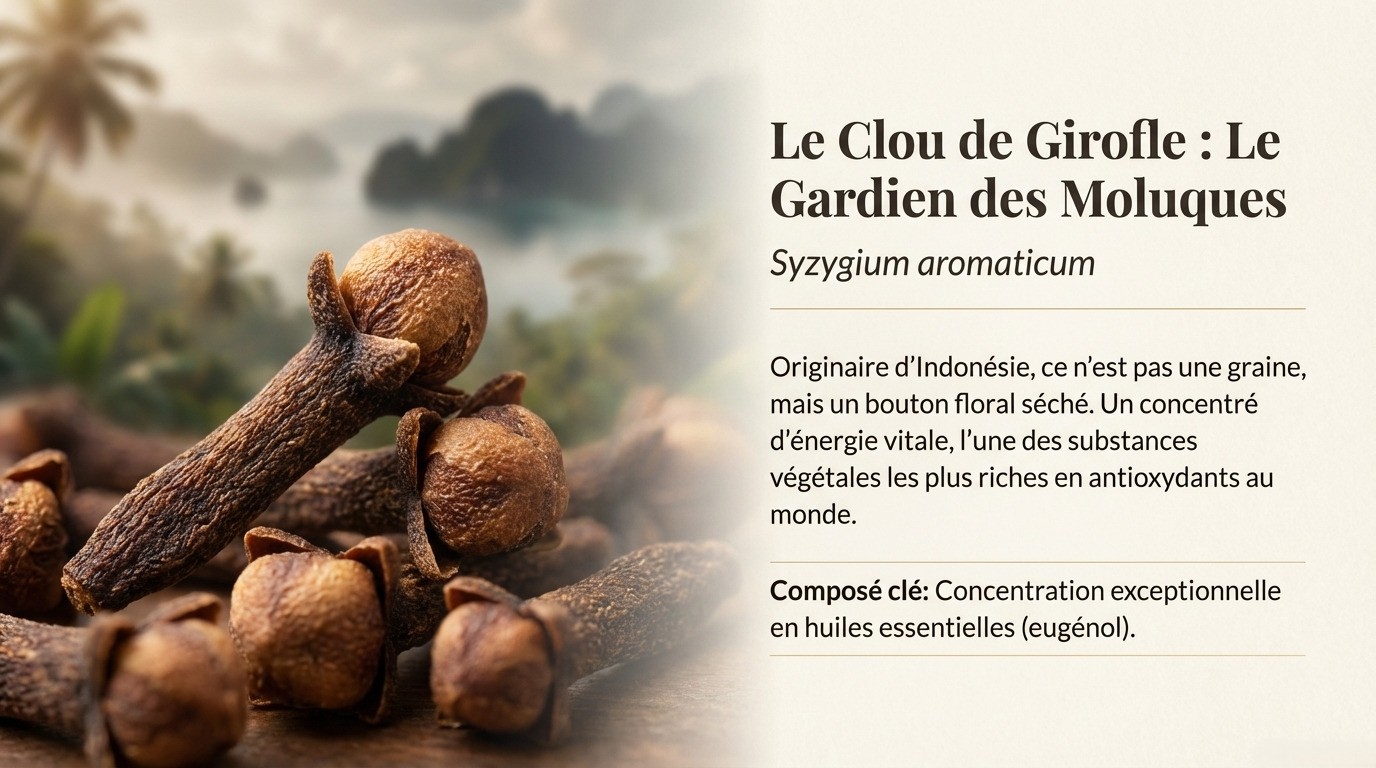
Whole cloves, sun-dried on Madagascar's eastern coast.
How to recognize high-quality cloves?
A good clove is judged first by eye and touch, then by smell. It should be whole, with a well-formed round head, an intact stem, and a rich brown color—neither blackened nor grayish. A broken, dusty clove or one whose head has fallen off has usually already lost much of its essential oils.
My favorite test, which I perform at markets, is very simple. I press a clove between two fingers. If it is high quality, it leaves a slightly oily, greasy mark, showing it is still rich in essential oils. Another fun test: submerged in a glass of water, a fresh, dense clove floats vertically, head up, while a dried-out, depleted clove floats horizontally on the surface. Finally, the fragrance should burst out as soon as you scratch the head. If you have to press hard, the spice is stale.
Arnaud's Take
I often perform the water glass test in front of customers. Seeing a clove stand proudly vertical is the best proof of freshness there is. No one forgets it afterwards.
How to use them in cooking?
The clove is a chameleon that spans both sweet and savory dishes. In classical cooking, it is best known studded into an onion to flavor a stew, stock, or roast. But its domain is far broader. It belongs in gingerbread, apple compotes, poached pears in wine, and iconic global spice blends like Indian garam masala or curries.
I prefer using whole cloves when a dish cooks for a long time, as they infuse gently and are easy to remove at the end. Ground cloves are fiercely potent and best reserved for baking, cake batters, spice mixes, and dry rubs. A trick I always use: I dry-roast my whole cloves briefly in a hot skillet before grinding them—just a few seconds suffice—and their aroma unfolds like never before. It is a master spice merchant technique I share in every workshop.
In Savory Dishes
Studded into an onion for stocks and stews, in marinades, cooking wine, tajines, or curries.
In Sweet Dishes
Gingerbread, apple compote, poached pears, mulled wine, hot chocolate, and winter teas.
| Form | Ideal for | The right technique |
|---|---|---|
| Whole clove | Stocks, stews, warm drinks | Add early, remove before serving |
| Ground clove | Baking, spice blends, marinades | Quick dry-roasting then fresh grinding |
| Studded in an onion | Stews, broths, roasts | Easy to retrieve at the end of cooking |
How to dose them without overpowering a dish?
Clove is undoubtedly the most concentrated spice in my shop, and that is where success or disaster is decided. One or two cloves are enough for a liter of stock. Three or four flavor mulled wine for a whole table. Beyond that, eugenol takes over, making the dish bitter, almost numbing on the tongue, and nothing can fix it.
My rule is simple and I repeat it in every workshop: you can always add another clove, but you can never remove an extra one. Start with the bare minimum, taste, and adjust. Ground clove requires even more caution, as a pinch equals several whole cloves. In a homemade spice blend, it should only ever represent a tiny fraction of the total, lest it overwhelm every other flavor.
Key Takeaway
Cloves do not forgive excess. One or two cloves per dish, taste, and only then adjust. A pinch of ground clove goes a very long way in any recipe.
What traditional uses are known for them?
Cloves carry a long history of traditional uses. In many cultures, they have been valued for their comforting fragrance and presence in daily rituals. They are found chewed to freshen breath, tucked into wardrobes to deter moths, or steeped in warm winter drinks alongside cinnamon and orange. This rich history is part of their charm.
I prefer to be transparent with you here: I talk about cloves as a culinary ingredient meant for enjoyment, not as a medical treatment. Traditional uses are a wonderful part of their heritage, but they never replace professional medical advice. For health-related questions, consult your doctor or pharmacist, not a spice rack.
- An invigorating fragrance appreciated for centuries in world cuisines
- A central place in warm spice blends
- An ancient household use for scenting linens
- A classic ingredient in comforting winter drinks
How to store them for a long time?
Good news: whole cloves are among the most stable spices in existence. Thanks to their high essential oil content and small exposed surface area, they keep their flavor for a very long time, often well past a year, provided you protect them from their three enemies: air, light, and humidity.
I store my cloves in an airtight glass jar, away from light, heat from the stove, and steam from the sink. Stored this way, they weather the seasons without losing potency. Ground clove, on the other hand, is fragile: once ground, the surface exposed to air increases drastically and the aroma evaporates within a few months. That is why I always recommend buying whole cloves and grinding them as needed. This guarantees intact intensity every time and prevents throwing away stale powder.
My three rules for storage
Always whole, never pre-ground
Airtight glass jar, away from light
Far from kitchen heat and moisture
What mistakes should you absolutely avoid?
The first mistake is overuse, as we have seen. The second is forgetting a whole clove in a dish and biting into it at the table: I always count my cloves when adding and removing them, or use the studded onion method which keeps them together. The third mistake is buying pre-ground clove and letting it age: that is the best way to think you dislike this spice, when you simply have never tasted it fresh.
Finally, many people store their spices right above the stove within easy reach. While convenient, that is the hottest and dampest spot in the kitchen, destroying aromas faster than anything else. A simple cupboard away from heat significantly extends the life of your cloves.
Cloves that retain their full potency
Discover my Madagascar cloves and spices at Le Comptoir de Toamasina, selected directly from farmers for their freshness and aromatic richness.
Discover my spicesFrequently asked questions
How many cloves per dish?
For a family dish or a liter of broth, one or two whole cloves are enough. For mulled wine to share, three or four. Clove is extremely concentrated: start low, taste, then adjust.
Can you eat whole cloves?
They are mainly used for flavoring and then removed, as their texture is tough and their flavor very intense. Chewed raw, they release a surprising intensity. In cooking, it is best to let them infuse and remove them before serving.
Can ground clove replace whole cloves?
Yes in a pinch, but with great restraint, as ground clove is more concentrated and loses aroma quickly. A tiny pinch equals several whole cloves. For stocks and broths, always prefer whole cloves, which are easier to dose and remove.