Your cart
There are no more items in your cart
Key takeaways
- A natural hybrid, not a species: the "x" in Vanilla x tahitensis denotes its hybrid origin, born from the crossing of Vanilla planifolia and Vanilla odorata in Mayan forest gardens.
- A unique profile: ethereal, floral, anisic, and fruity (prune, cherry, almond), it smells more like a perfume than a spice.
- Its chemical signature: low in vanillin, but uniquely rich in anisyl compounds and heliotropin.
- Fragile to heat: its floral aromas evaporate when cooked, so it must be used cold or at the very end of cooking.
- An absolute rarity: representing barely 0.25% of global vanilla production, making it a true luxury product.
If there is one vanilla that divides and fascinates in equal measure, it is Tahitian vanilla. Those who have smelled it once never forget it: where Madagascar Bourbon envelops you with warmth and caramel, Tahiti surprises you with a floral and anisic freshness, almost like the scent of a florist shop. Many people think they know everything about it, and are wrong about almost everything. No, it is not a vanilla that has always been grown in Polynesia. No, it is not a modern invention. Its history is much more beautiful than that.
What is Tahitian vanilla?
Tahitian vanilla goes by the scientific name of Vanilla x tahitensis J.W. Moore. This little "x" is not just for show, it is crucial information: it indicates that we are not dealing with a classic wild species, but with a hybrid, meaning the offspring of a cross between two different species. In the Tahitian language, it is called tumuvanira, and the whole world calls it the black gold of Polynesia.
It is a climbing vine, like all vanillas, capable of reaching over twenty meters in height by clinging to host trees. But everything about it sets it apart from its Madagascar cousin: its pods, its chemistry, its scent, its curing method. It is another expression of vanilla, a finer, more musical expression.
Where does this hybrid vanilla really come from?
This is my favorite chapter to tell. Genetic and ethnohistorical analyses published in 2008 by Pesach Lubinsky's team solved what was known as the mystery of Tahitian vanilla. This vanilla was born from a spontaneous cross between Vanilla planifolia, the mother, and Vanilla odorata, the father, a very rare wild species. And this cross did not happen by chance in the jungle: it occurred in the forest gardens of the Maya, between 1350 and 1500, in Guatemala.
The Maya cultivated several species of wild vanilla together in their plots to flavor their sacred cacao. By physically bringing together two species that never crossed in nature, they unintentionally allowed them to hybridize. Tahitian vanilla is therefore both a biological miracle and a true Mayan cultural artifact. That is why I love telling my customers that when they taste a Tahitian pod, they are unknowingly tasting the agricultural genius of a lost civilization.
It then took the chance of colonial trade routes to bring it to the Pacific tropics. In 1848, French Admiral Ferdinand-Alphonse Hamelin introduced plants to Polynesia, having brought them from the Philippines, where Spanish galleons had taken them from the New World. Local selections in the humid valleys of Taha'a and Raiatea did the rest. In 1933, botanist John William Moore finally described the species scientifically, using vines that had gone wild again on the island of Raiatea.
Tahitian vanilla: a unique journey and pods twice as plump and moist as Madagascar's.
How do you recognize a Tahitian pod?
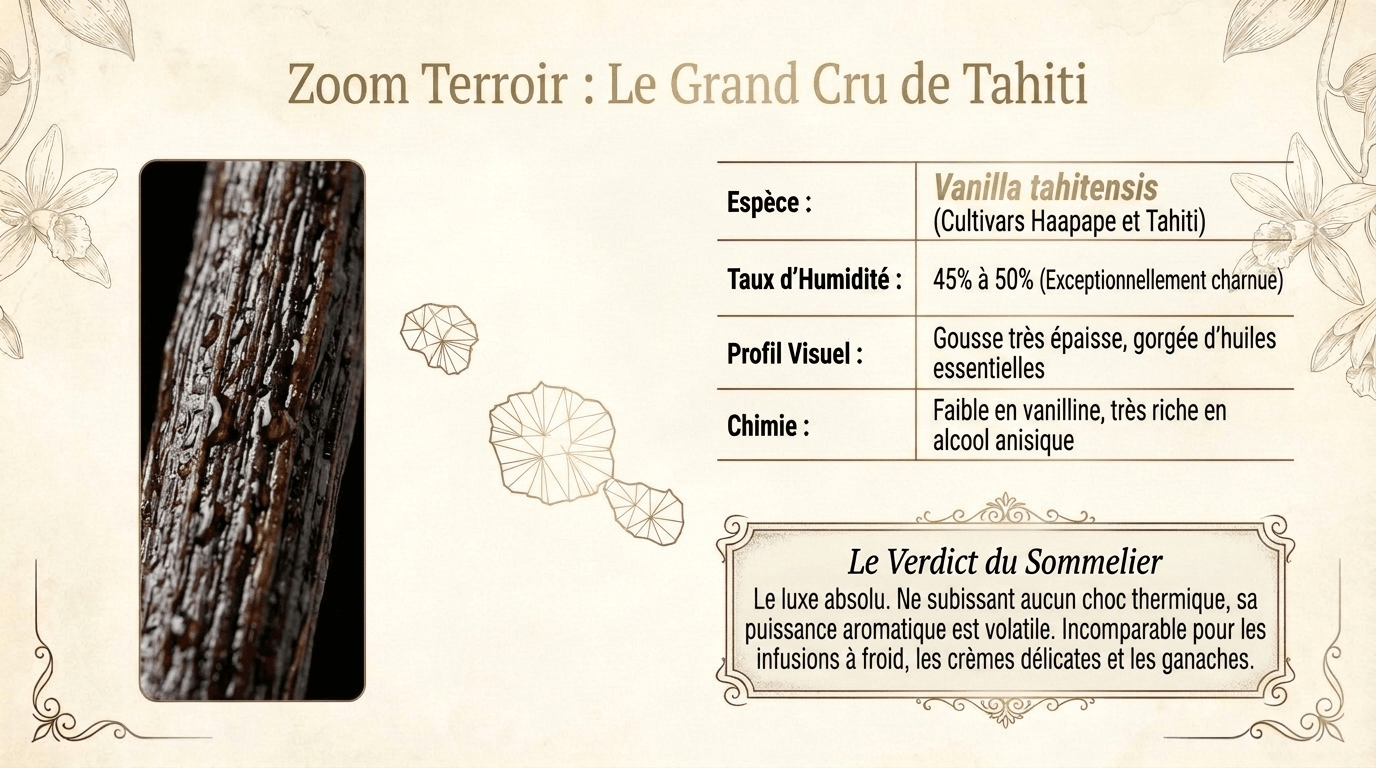
Place a Madagascar pod next to a Tahitian pod, and your eyes will immediately understand. The Tahitian is shorter and much wider, twelve to eighteen centimeters long and a good centimeter and a half wide. It is fleshy, plump, thick, shiny, of a deep reddish-brown. Above all, it is greasy and incredibly moist: its moisture content when sold is between 45 and 60%, while other vanillas peak at 25 or 35%. You can tie it around your finger without it breaking.
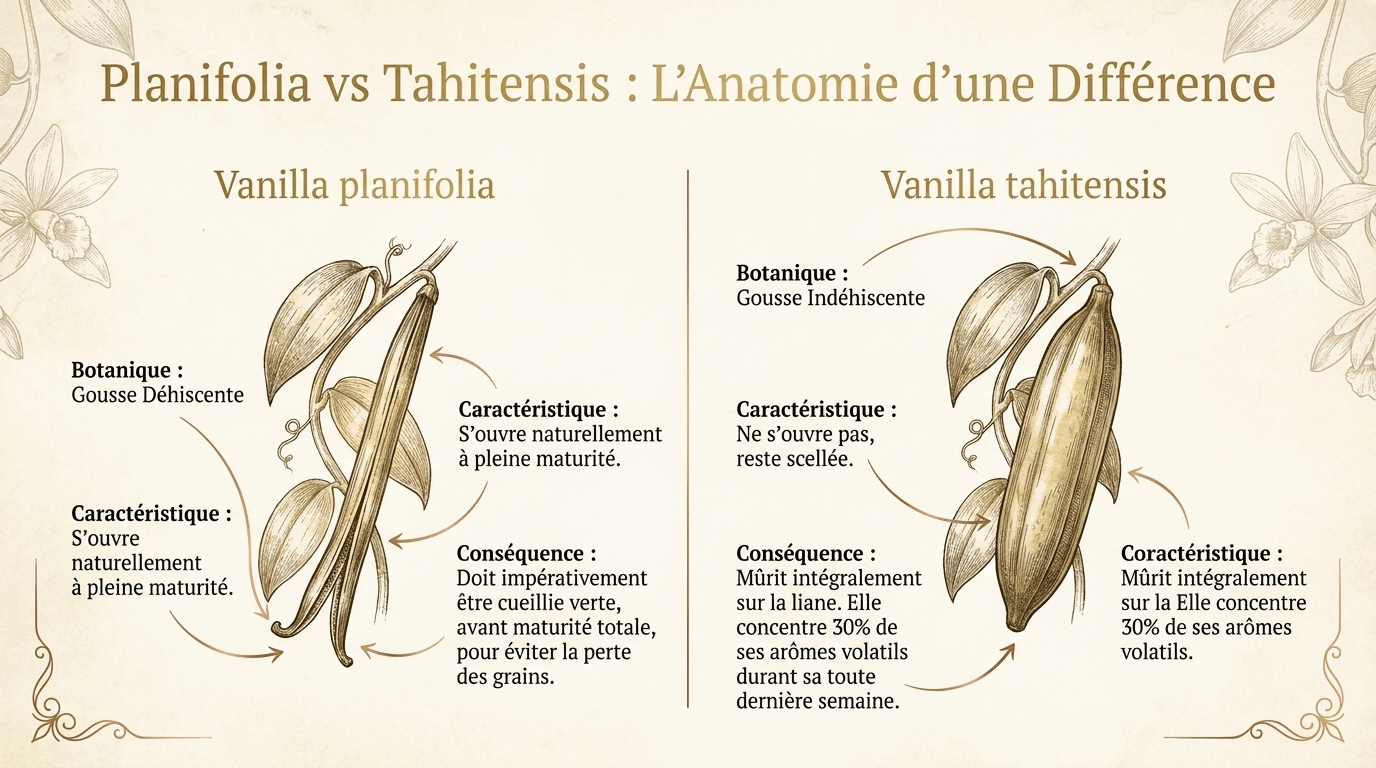
It also has a decisive botanical characteristic: it is indehiscent. Unlike Bourbon, which splits in two at maturity and must therefore be picked green, the Tahitian pod does not open. You can let it fully ripen on the vine for ten months, which changes everything about its scent. You will also almost never see vanillin frost (crystals) on its surface, as its pure vanillin concentration is low. Its secret lies elsewhere.
What is its aromatic profile?
The bouquet of Tahiti is a garden. First, you find white flowers and lilac, fresh green anise, and sweet almond. Then come the fruits: prune, cherry compote, fig, set against a background of soft caramel and buttery gingerbread. And finally, warm notes of tonka bean, cacao, and fine leather. It is a smooth, ethereal, delicate vanilla, often described more as a "perfume" than a "spice".
Tahitian vanilla olfactory pyramid
Top NotesWhite flowers, lilac, green anise, sweet almond
Heart NotesPrune, cherry, fig, caramel, gingerbread
Base NotesTonka bean, warm cacao, fine leather, woody vanilla
What does the chemistry of this vanilla say?
Tahiti's signature comes down to one word: anisyl. Where Bourbon is 80 to 85% dominated by vanillin, Tahiti contains much less, between 1 and 2% of the dry matter, but is exceptionally rich in anisyl compounds, which make up 1.4 to 2.1% of the pod, compared to mere traces in Bourbon. It is this combination, led by anisyl alcohol, anisaldehyde, and heliotropin, that gives it its facets of anise, sweet licorice, bitter almond, and cherry blossom. It also contains about 15% fat, which carries its aromas and gives it its oily feel.
Good news for cautious gourmets: unlike pompona (Vanilla pompona), Tahitian vanilla contains no coumarin. It is a pure luxury food product, with no dosage restrictions.
How does it differ from Bourbon vanilla?
This is the comparison I am asked for the most. It boils down to three major differences.
| Criterion | Tahitian Vanilla | Bourbon Vanilla (Madagascar) |
|---|---|---|
| Profile | Ethereal, floral, anisic, fruity (cherry, prune) | Warm, fatty, woody, caramel, chocolate |
| Vanillin | Low (1 to 2%) | High (1.7 to 3.6%) |
| Heat Resistance | Low: best used cold | Excellent: ideal for cooking |
| Pod | Short, wide, very moist, indehiscent | Long, thin, dehiscent (splits) |
| Moisture | 45 to 60% | 25 to 35% |
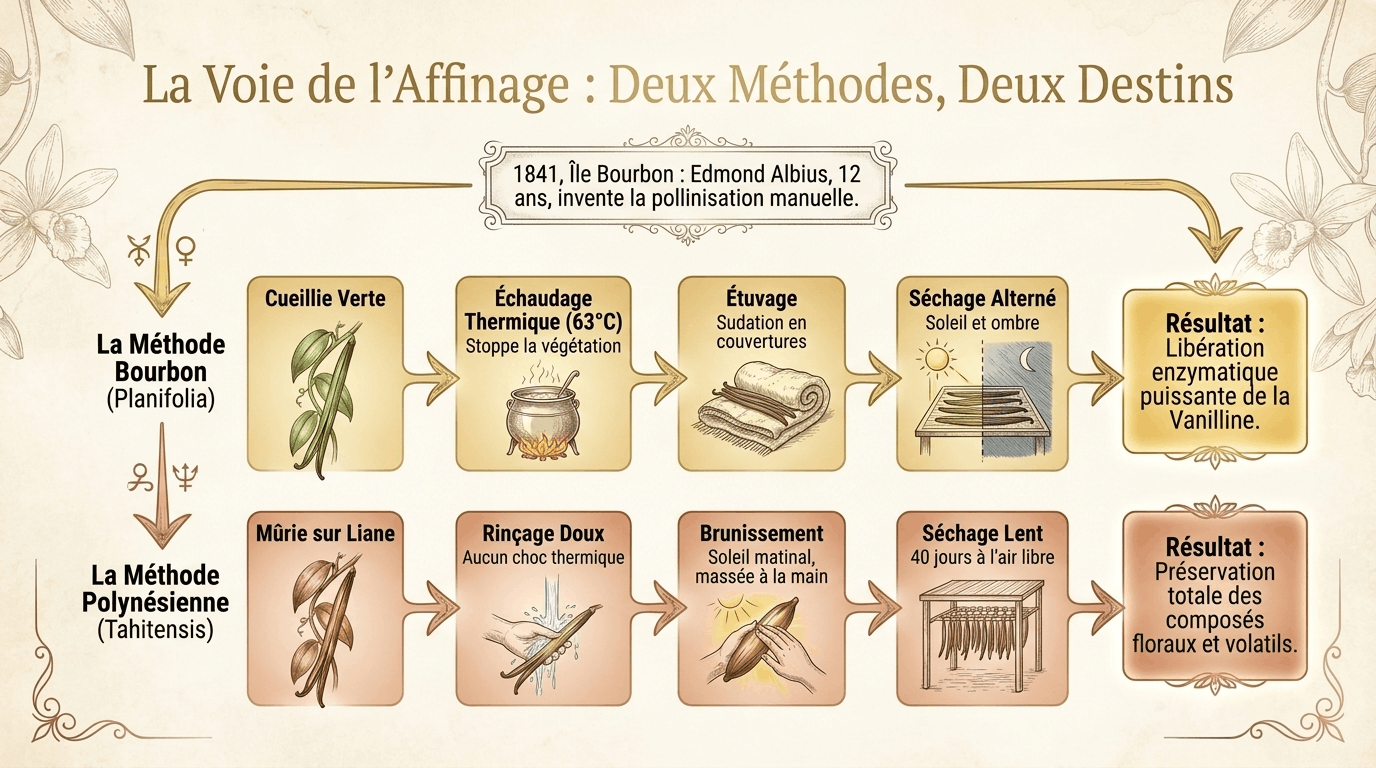
One point worth noting: the same species grown in Papua New Guinea, the world's second-largest producer, yields a very different result. In Tahiti, the pod is prepared cold, without scalding, which preserves the floral and anisic notes. In Papua, they often use the Bourbon method with hot water scalding, which transforms the chemistry and brings out woodier notes of gingerbread, leather, and rum. Same seed, two vanillas.
Why isn't it scalded like Bourbon?
Because it doesn't need to be, and doing so would destroy it. Thanks to its indehiscence, the Tahitian pod ripens for a full ten months on the vine, three months longer than Bourbon. Its walls soften naturally, and the enzymatic process starts while still on the plant. It is estimated that 30% of its aromas form during the very last week on the vine. Scalding it in boiling water would kill its highly volatile floral esters.
The Tahitian preparation is a craft of patience. The pods are washed, dried in the mild morning sun, and left to sweat in the afternoon in wool blankets. Then comes the signature gesture: each pod is massaged and smoothed by hand, one by one, several times, to distribute the pulp and soften the skin. Finally, a long curing in wooden trunks for several months finishes the bouquet. It is this manual labor, combined with its rarity, that explains a price often hovering around €800 per kilo for Gourmet grade.
What are its best culinary uses?
The golden rule can be summed up in one sentence: Tahitian vanilla should be used cold or at the very end of cooking. Its light anisic compounds evaporate in the heat and would leave only a bland aftertaste. It is therefore made for whipped creams, mousses, panna cottas, white chocolate ganaches, fresh fruit salads, and premium gelatos. Add its seeds after cooking, never into a blazing oven.
As for pairings, it is sumptuous with red and tropical fruits, but also, in savory dishes, with lightly seared scallops, a delicate white fish, or a white agricultural rum cocktail. It is the vanilla for pastry chefs seeking elegance over power.
Good to know: the great Tahitian cultivars.
The "Tahiti" cultivar, from the original stock, produces smaller pods but is highly concentrated in floral and anisic notes. The "Haapape" cultivar, developed locally, produces longer and fleshier pods, with rounder chocolate and caramel aromas, and its leaves have a characteristic central groove. A third, the "Rea Rea" (yellow), is among the most fragrant in Polynesia.
Arnaud's Opinion
Tahitian vanilla is not a better vanilla than Bourbon, it is a *different* vanilla. I advise against using it in your baked cakes and custards, where it would get lost. But for whipped cream, a white ganache, or a strawberry salad, it transforms a dessert into a memory. It is a finishing vanilla, a vanilla of emotion. And when you know its Mayan history, you respect it even more.
1350 - 1500Spontaneous hybridization of V. planifolia and V. odorata in Mayan forest gardens in Guatemala.
1848Introduction to Polynesia by Admiral Hamelin, from plants brought over from the Philippines.
1933Official scientific description of the species by botanist John William Moore, in Raiatea.
2008DNA analyses by Lubinsky prove the hybrid and neotropical origin of Tahitian vanilla.
TodayLess than 0.25% of global production, a luxury product protected by French Polynesia.
Discover our Tahitian vanilla
Treat yourself to the most floral of vanillas, selected pod by pod, and explore the entire universe of world vanillas at our shop.
View Tahitian VanillaFrequently Asked Questions
Was Tahitian vanilla created in a laboratory?
No, that is a colonial-era legend. DNA analyses have proven that it is the result of spontaneous natural hybridization that occurred several centuries ago in the forest gardens of the Maya, in Guatemala.
Why is it so expensive?
Its extreme rarity (less than 0.25% of global production) is combined with a very slow artisanal preparation, including the manual massaging of each pod. It often trades around €800 per kilo in Gourmet grade.
Can it be baked in the oven?
It is best avoided. Its anisic and floral aromas are highly volatile and break down at high temperatures. Add its seeds at the end of cooking or in cold preparations to preserve its entire bouquet.
Does it contain coumarin?
No. Unlike the pompona (Vanilla pompona), Tahitian vanilla is devoid of coumarin and perfectly suited for prestigious culinary use without restrictions.
What is the difference between Tahiti and Madagascar Bourbon?
Bourbon is warm, rich, and withstands cooking, making it ideal for classic baking. Tahiti is floral, anisic, and fragile to heat, reserved for cold preparations and finishing fine desserts.