Your cart
There are no more items in your cart
Key takeaways
- A global epicenter: Brazil is home to 36 native vanilla species, of which 20 are strictly endemic, spread across four major biomes.
- Unique profiles: far from the standard sweet vanilla, Brazilian vanillas offer notes of blond tobacco, licorice, candied fruits, and precious woods.
- Extraordinary pods: banana vanilla (Vanilla pompona) reaches 25 cm and weighs up to 30 to 40 g, compared to 3 g for a Madagascar pod.
- A 200-year-old tradition: in the state of Goiás, vanilla has been cured in cane sugar for over two centuries.
- A challenge for the future: EMBRAPA has created the country's first vanilla germplasm bank to preserve this irreplaceable genetic reservoir.
When you think of vanilla, you think of Madagascar, Tahiti, perhaps Mexico. Almost never Brazil. And yet, it is here, in this land where I have lived since 2015, that one of the greatest diversities of vanilla on the planet is hidden. A secret continent of black gold, long ignored by food lovers, which researchers and a few pioneering chefs are now revealing to the world. Let me take you on a journey to discover Brazilian vanillas—wild plants with a very strong character.
Why is Brazil considered a land of vanillas?
The numbers are staggering. Brazil is officially home to 36 native species of the Vanilla genus, according to the national Reflora program, and more than 40 according to the most recent revisions. Better yet, 20 of these species—more than half—are strictly endemic: they grow nowhere else on Earth. This makes Brazil one of the world's main epicenters of evolutionary and genetic diversity for vanilla.
This richness is explained by the variety of Brazilian landscapes. The vanillas here are almost all hemiepiphytic vines, which begin their lives on the ground or perched before climbing toward the canopy light. They need humidity, heat, and a short dry season to flower. And depending on the biome where they grow, they have developed radically different personalities.
What are the major terroirs of Brazilian vanilla?
Four major biomes share this diversity, each with its own signature.
| Biome | Diversity | Character |
|---|---|---|
| Atlantic Forest (Mata Atlântica) | 18 species, 14 endemic | The cradle of speciation, fragmented rainforest |
| Amazon | 17 species, 4 exclusive | Great richness, strong gene flow |
| Cerrado | 7 species | The wooded savanna, adapted to water stress |
| Caatinga | Robust species | The semi-arid Northeast, the most extreme |
The Atlantic Forest, that thin ribbon of rainforest bordering the coast, is by far the most creative: its rugged topography isolated populations and gave rise to a bloom of unique species. The Amazon, being more continuous, instead favors genetic exchange. The Cerrado, the vast savanna, forged hardened vanillas. And the Caatinga, the thorny desert of the Northeast, hosts only the toughest.
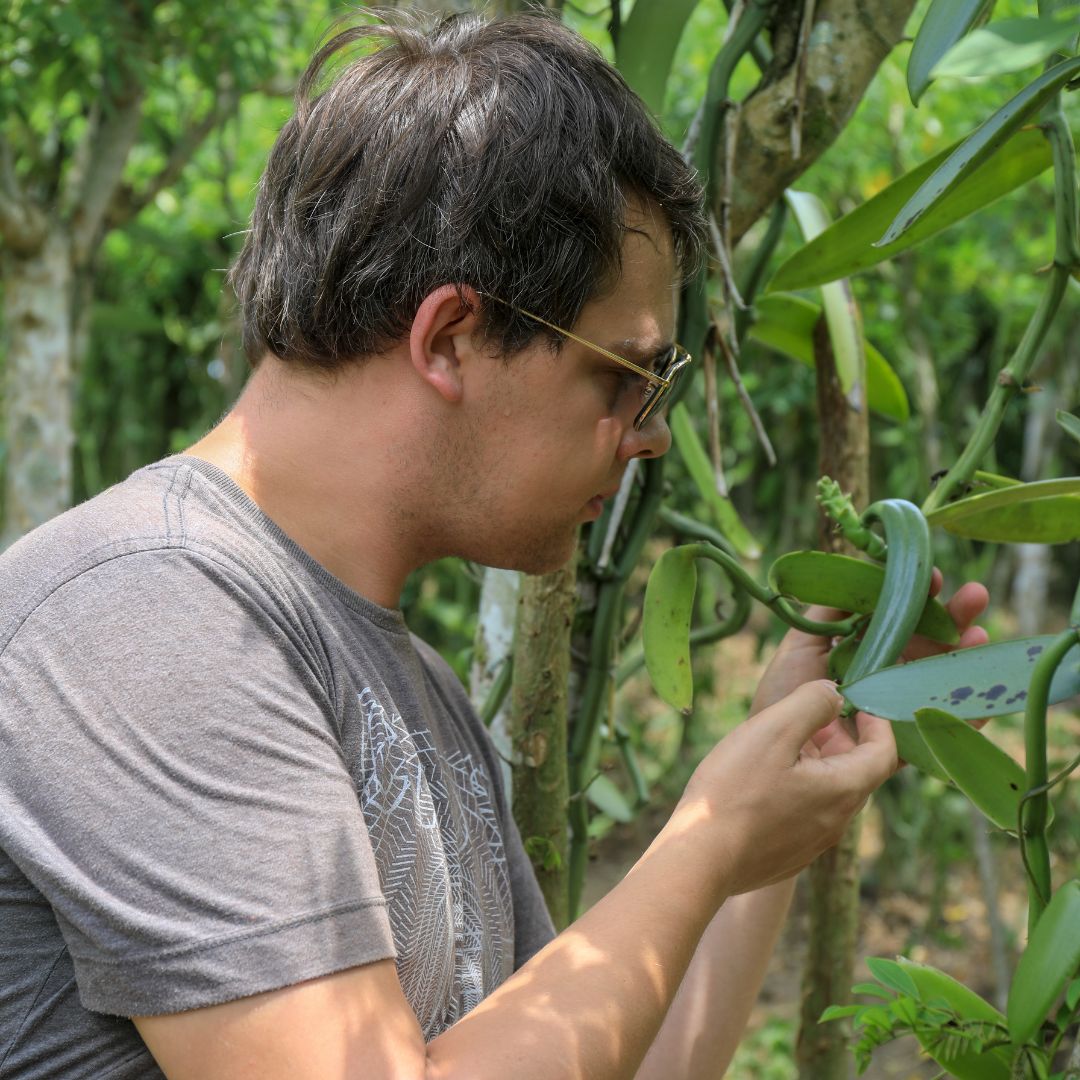
Vigorous vines in their natural habitat: a unique botanical heritage.
Which are the major Brazilian vanillas you should know?
Out of the dozens of species recorded, a few stand out for their history, their fragrance, or their potential. These are the ones I invite you to discover first, each having a dedicated guide on our blog.
The most iconic is banana vanilla (Vanilla pompona), also called Cerrado vanilla. Its giant pods, up to 25 cm long, weigh 30 to 40 grams each—ten times more than a Madagascar pod. Its captivating scent blends candied fruit, blond tobacco, and licorice. Next is Bahia vanilla (Vanilla bahiana), the perfumery vanilla, with intensely woody and smoky notes carried by guaiacol. Then comes Chamisso vanilla (Vanilla chamissonis), a delicate vine of the Atlantic Forest with aromas of honey, anise, and clove, which takes eighteen months to ripen. And finally, the Maya vanilla (Vanilla cribbiana), found as far as the Amazon, the fattiest small pod in the world.
| Species | Biome | Aromatic Signature |
|---|---|---|
| Vanilla pompona (banana) | Amazon, Cerrado | Candied fruit, blond tobacco, licorice |
| Vanilla bahiana | Caatinga, Cerrado, Atlantic Forest | Woody, smoky, balsamic, spicy |
| Vanilla chamissonis | Atlantic Forest | Honey, anise, clove |
| Vanilla cribbiana (maya) | Amazon (and Mesoamerica) | Chocolate, mocha, cherry, very fatty |
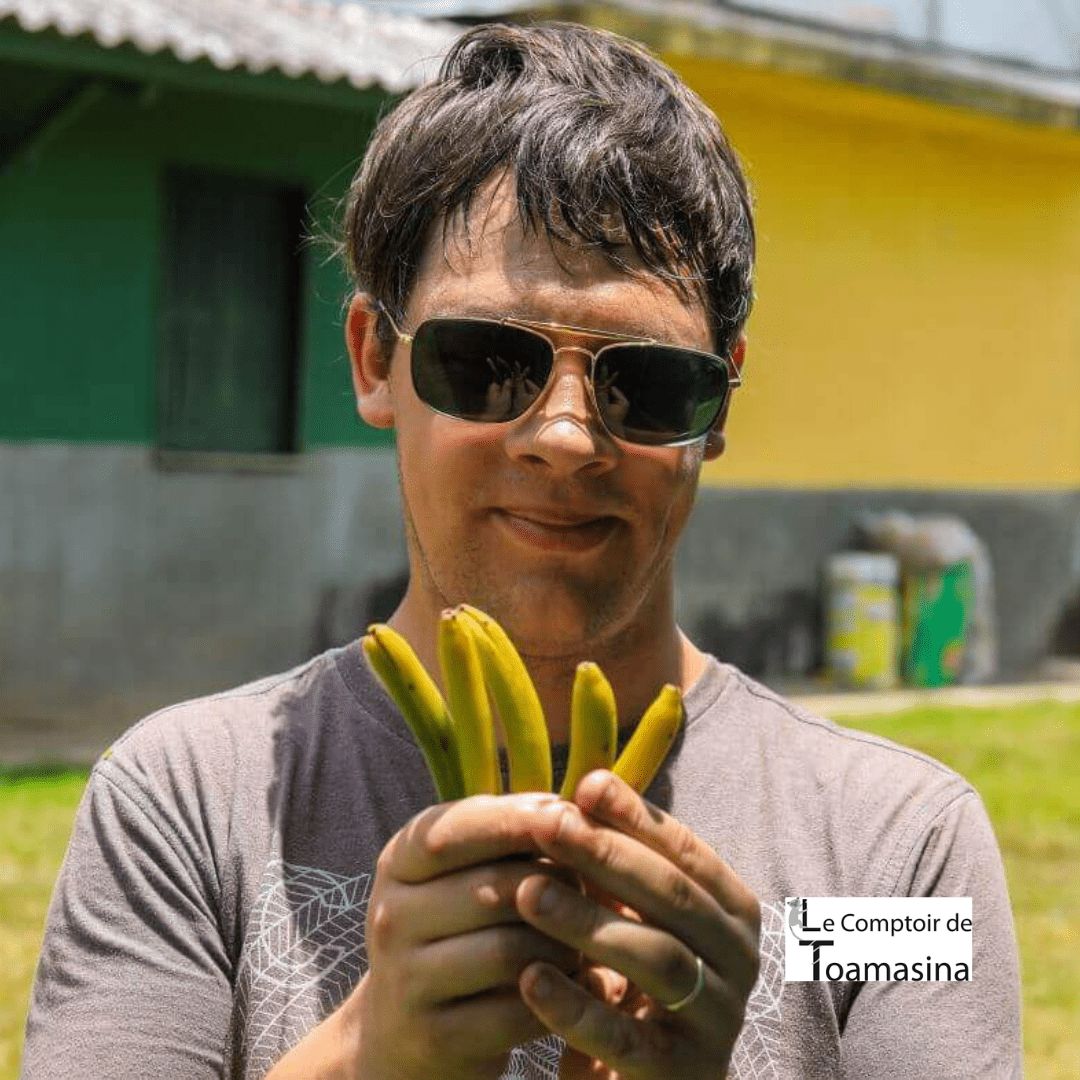
Arnaud Vanille with Bahia vanilla pods, one of the most aromatic and rare species in Brazil.
What is the aromatic profile of Brazilian vanillas?
This is where they redefine everything. Forget the purely sweet, smooth vanilla of the industry. Brazilian wild vanilla, or baunilha nativa, plays a much darker, more complex tune. It features a fruity and tart attack, a floral heart marked by licorice and wild anise, and a deep, persistent base of blond tobacco, candied fruit, dark caramel, and oily resins. It is a vanilla of character, made for curious palates and haute cuisine.
Baunilha nativa olfactory pyramid
Top NotesFruity, tart, fresh, exotic zest
Heart NotesFloral, licorice, wild anise
Base NotesBlond tobacco, candied fruit, dark caramel, resin
A fascinating point measured by science: several of these vanillas have a much lower aromatic detection threshold than Bourbon vanilla. In simple terms, you need less of it to flavor a dish to the same degree. And their woody and spicy notes hold up remarkably well to heat, whereas floral vanillas evaporate.
How are they prepared and cooked?
Brazil invented its own curing traditions, very different from the Bourbon method. The most fascinating one comes from the State of Goiás, where local populations have been curing vanilla directly in cane sugar for over two hundred years. The ripe pods are buried in sugar, which develops incomparable notes of candied fruit. It is an empirical know-how, passed down from generation to generation, which haute cuisine is now rediscovering.
Brazilian cuisine also has a radical approach to the pod itself. Where the French tradition only uses the small seeds inside, Brazilian gastronomes, like Claudia Nasser, blend the entire cured pod in a food processor to make a paste. The reason is simple: the pericarp of these wild vanillas is thick, oily, and bursting with aromatic compounds. Throwing it away would be a waste. In terms of pairings, these vanillas elevate artisan ice creams just as well as savory dishes—a fish in cream sauce, pork with Cerrado citrus jelly, or even ground coffee.
A precaution to know.
Some wild Brazilian vanillas, particularly the banana vanilla, are naturally rich in coumarin—a molecule that traditionally restricts its culinary use to low doses and gears it towards perfumery. Others, like chamissonis, contain irritating crystals in their raw pods. These vanillas are never consumed raw and always require full curing. This is also why laboratories are working to precisely quantify these molecules before any widespread industrial use.
The blind tasting that changed everything
In October 2021, Danish chef Simon Lau, based in Brasília, gathered thirteen elite guests, including eight EMBRAPA scientists, for a blind tasting of seven vanilla ice creams. Two were made with vanillas imported from Madagascar and Polynesia, and two with wild Cerrado vanillas harvested near Goiás Velho.
Unanimously, the tasters preferred the ice cream made with Vanilla pompona, cured in sugar according to the bicentennial local method. On that day, Brazilian vanilla proved, blindly and before scientists, that it had nothing to envy the world's greatest. It is a story I love to tell, because it says it all: the Brazilian terroir is not a curiosity, it is a revelation.
Why are these vanillas a treasure for the future?
Beyond pleasure, there is a vital issue at stake. Global vanilla relies almost entirely on a single cloned species, Bourbon, making it terribly vulnerable to diseases like fusarium wilt and to climate change. Wild Brazilian vanillas, on the other hand, are an immense reservoir of genes for resistance and hardiness. That is why EMBRAPA inaugurated Brazil's first vanilla germplasm bank in Brasília, preserving over 70 samples, with three goals: to domesticate these species to replace wild harvesting, to cross their resistance genes with cultivated vanillas, and to prevent their silent disappearance in the face of advancing soy, sugarcane, and pastures.
Fascinating ecology.
These vanillas conceal mechanisms worthy of a novel. Many practice food deception: their highly fragrant flowers offer no nectar, tricking bees into pollinating them. Chamissonis and its cousin exhibit delayed sterility, where self-pollination fails and causes the fruit to abort after three or four months, forcing them into cross-pollination. And their large, bitter pods, which take eighteen months to ripen, are dispersed only by a rodent, the agouti, the only animal capable of tolerating their bitterness. Some Amazonian species are even pollinated by hummingbirds. Brazilian vanilla is a festival of nature's inventions.
Arnaud's Opinion
Living in Brazil has changed my perspective on vanilla. I grew up, professionally, with Madagascar Bourbon, and I still love it just as much. But here, I understood that vanilla was a much vaster and wilder genus than people believe in Europe—a whole world left in the shadow of three commercial species.
These Brazilian vanillas will not replace Bourbon in your everyday custards, and that is not their role. But they tell another story, that of threatened biodiversity that we must taste, understand, and protect. That is exactly my purpose since 2010: not to sell illusions, but to pass on expertise and defend the true wealth of vanilla—its diversity.
Are these wild vanillas threatened?
Yes, severely. Deforestation of the Amazon and the Atlantic Forest destroys their habitats, while global warming desynchronizes the vines from their pollinators (bees and hummingbirds), leading to an estimated threat of decline between 60 and 90%. Several species are already classified as endangered. Faced with this, conservation relies on gene banks, the creation of micro-reserves that also protect the symbiotic fungi essential for germination, and agroforestry—growing these vanillas under the canopy of forests managed by local communities. To protect Brazilian vanilla is to protect the forest itself.
Explore vanillas of the world
From Brazil to Madagascar, discover the full diversity of rare vanillas that we select and tell the stories of at our shop.
Discover our world vanillasFrequently Asked Questions
How many vanilla species exist in Brazil?
The national Reflora program records 36 native species, and recent revisions count more than 40. Twenty of them—more than half—are strictly endemic to Brazil.
Is Brazilian vanilla really more potent than Madagascar vanilla?
For several species, yes. Studies show that vanillas like chamissonis or maya have a lower aromatic detection threshold than Bourbon: you need less of it to flavor a dish just as much.
What is sugar curing?
It is a traditional method from the State of Goiás, practiced for over two hundred years, where ripe pods are cured directly in cane sugar, developing intense notes of candied fruit.
Is it easy to buy Brazilian vanilla?
No, its production remains ultra-exclusive and largely comes from wild harvesting. It is currently reserved for very high-end local gastronomy and sustainable cultivation projects supported by EMBRAPA.
Why should some of these vanillas not be eaten raw?
Because their green pods contain defense compounds, like irritating oxalate crystals or strong astringency. They always require a complete curing process, and some, rich in coumarin, must be used in moderation.