
Your cart
There are no more items in your cart
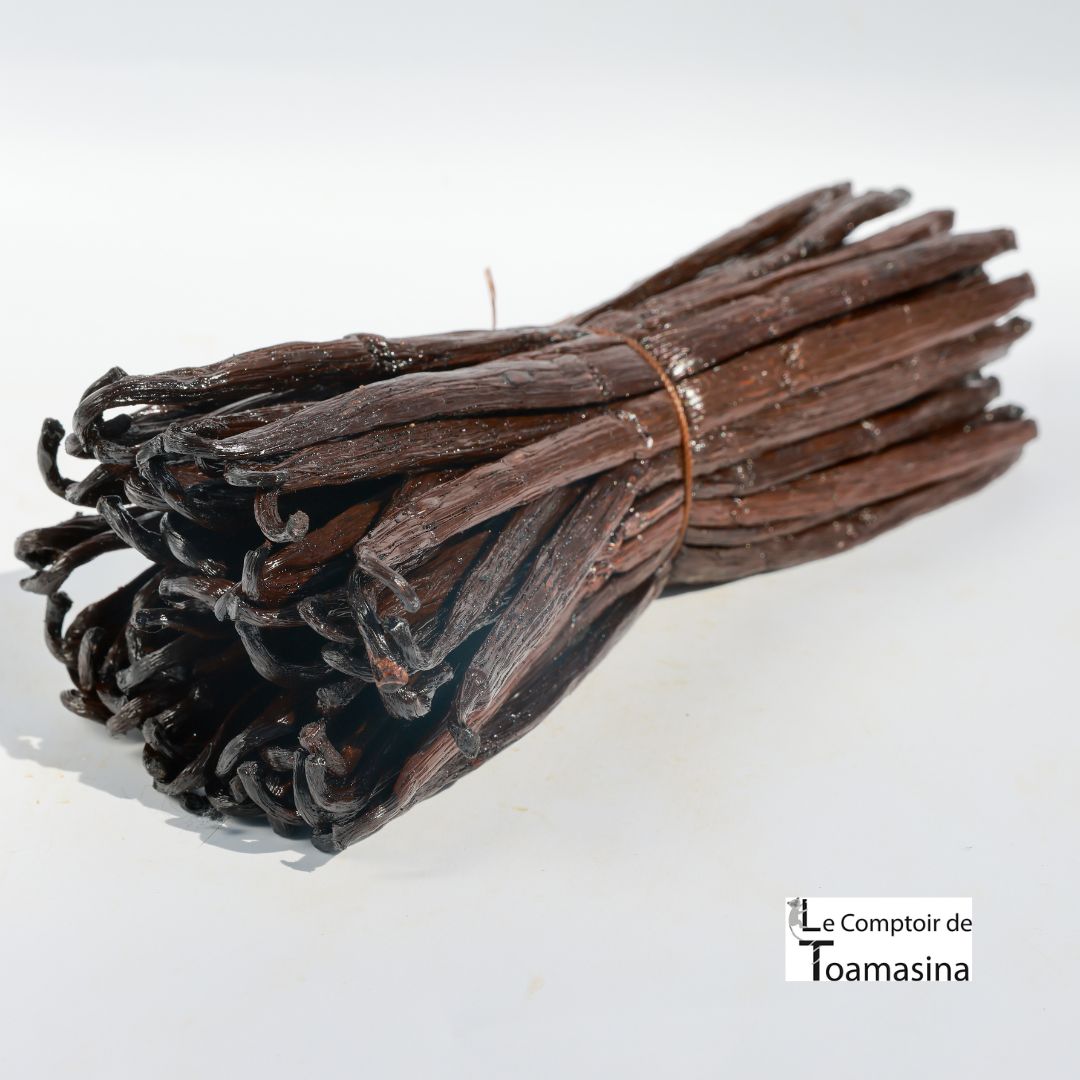
Key Takeaways
- The ISO 5565 standard (parts 1 and 2) officially governs vanilla grading and laboratory testing methods — it is the sole legal reference.
- Gourmet (Grade A): supple, moisture content 30–35%, vanillin 1.5–1.8%. The only quality offered on our store.
- TK (Grade B): semi-split, moisture content 25–30%, vanillin 1.4–1.7%. Excellent for long infusions and extracts.
- Red (Grade C): very dry bean, used exclusively for industrial processing (~700 beans per kg).
- Terms like "Grand Cru", "XXL", or "Prima" do not exist in official standards — they are purely commercial marketing labels without normative value.
Why this topic matters so deeply to me
I founded Le Comptoir de Toamasina in 2010 with one non-negotiable rule: selling exclusively Gourmet grade vanilla. Back then, transparency in the trade was rare. Today, many new sellers take advantage of consumer confusion around grades to sell Red or TK vanilla at Gourmet prices under attractive commercial names. I wrote this guide based directly on official ISO documentation rather than commercial marketing claims.
The ISO 5565 standard: the only legal reference
To standardize vanilla quality globally, the International Organization for Standardization (ISO) established technical specifications under reference ISO 5565. The standard comprises two parts:
| Part | Scope |
|---|---|
| ISO 5565-1 | Specifications for vanilla (Vanilla fragrans): product definitions and category classifications |
| ISO 5565-2 | Test methods: laboratory chemical analysis for vanillin, vanillic acid, 4-hydroxybenzaldehyde, and 4-hydroxybenzoic acid |
The standard recommends High-Performance Liquid Chromatography (HPLC) to test these compounds. If a vendor advertises a specific vanillin percentage, you are entitled to request official laboratory test results conducted in France.
An important detail. While ISO 5565 defines test methods and grades, it does not set a mandatory minimum vanillin percentage for each grade, as natural vanillin varies by origin and curing. Therefore, moisture content is the primary criterion used to distinguish official grades.
The three official grades explained
Three main grades structure the market: Gourmet, TK, and Red. Here is what truly sets them apart according to official technical criteria:
Gourmet Vanilla (Grade A)
- Moisture
- 30% to 35%, up to 38% depending on curing
- Vanillin
- Typically 1.5% to 1.8% for Madagascar vanilla
- Appearance
- Supple, oily, heavy, uniform dark brown without splits; wraps around a finger without breaking
- Usage
- Scraping seeds, fine pastry, culinary tasting, direct infusion
TK Vanilla (Grade B)
- Moisture
- 25% to 30%
- Vanillin
- Typically 1.4% to 1.7%
- Appearance
- Firmer than Gourmet, often showing reddish streaks or light splits from drying
- Usage
- Homemade extracts, long infusions, spiced rum — its lower moisture makes it extremely shelf-stable
Red Vanilla (Grade C)
- Moisture
- Lowest moisture level among all grades
- Appearance
- Reddish to light brown, dry, brittle, wood-like texture
- Usage
- Industrial use exclusively: flavor extraction, powders, vanilla sugar
| Grade | Moisture | Vanillin | Appearance | Usage |
|---|---|---|---|---|
| Gourmet (A) | 30–35% | 1.5–1.8% | Supple, oily, dark brown | Direct culinary use, fine baking |
| TK (B) | 25–30% | 1.4–1.7% | Firmer, reddish streaks | Extracts, long infusions, spiced spirits |
| Red (C) | Lowest | Variable | Dry, brittle, reddish-brown | Industrial extraction, powders |
Commercial names and the reality of the ISO 5565 standard
In the online vanilla trade, it is common to come across attractive designations such as "Vanilla Grand Cru", "Vanilla Bourbon Gold", "Vanilla Prima", "Brown Vanilla", or "Vanilla XXL".
From a strictly regulatory and normative standpoint, none of these terms have any definition in the ISO 5565-1 standard. They are commercial names or private labels created by sellers to qualify their own selection.
While they may reflect a marketing intent to highlight a product, they provide no universal normative guarantee regarding official grade (A, B, or C), exact moisture percentage, or laboratory-tested vanillin levels.
What you need to know for your purchase.
The only legally and internationally recognized grading system is established by ISO 5565 (based on moisture analysis and HPLC chromatography testing for aromatic compounds). To avoid confusion, we recommend always referring to official standard criteria rather than commercial descriptors.
The only legally and internationally recognized grading system is established by ISO 5565 (based on moisture analysis and HPLC chromatography testing for aromatic compounds). To avoid confusion, we recommend always referring to official standard criteria rather than commercial descriptors.
How to identify vanilla grades by sight and touch
| Observed Feature | What It Indicates |
|---|---|
| Bean bends smoothly around a finger without cracking | Good sign of Gourmet quality (provided it isn't artificially waterlogged) |
| Reddish streaks along the outer skin | Typical characteristic of TK grade |
| Rigid, brittle bean with wood-like texture | Red grade, suited for extraction |
| Sparkling white needle-like crystals on surface | Natural vanillin crystallization — a sign of exceptional aromatic richness |
What I concretely do for every batch
I never rely on simple commercial promises. For every batch I purchase, I require the importer to provide all laboratory analysis reports conducted in France (specifically HPLC vanillin testing and exact moisture content measurements). Upon arrival, I perform a rigorous physical inspection of the overall quality (flexibility, integrity, aromatic profile). Anything that does not meet the strict requirements of certified Gourmet vanilla under ISO 5565 is simply never offered on my website.
▶
Watch my detailed breakdown on Comptoir de Toamasina's YouTube channel.
Explore our premium selection
Discover our vanilla beans selected in strict accordance with the criteria of the ISO 5565 standard.
FAQ — Vanilla Grading & Standards
What is the ISO 5565 standard?
It is the official international standard defining vanilla specifications (part 1) and laboratory analysis methods (part 2). It is the sole legal reference for vanilla grading.
What is the difference between Gourmet and TK vanilla?
Gourmet vanilla has 30–35% moisture content and a supple texture. TK vanilla is drier (25–30%) with reddish streaks, ideal for extracts and long macerations.
Is Red vanilla bad quality?
No, it is simply meant for a different purpose: industrial extraction. The issue only arises when it is sold as Gourmet vanilla at inflated prices.
Are terms like "Bourbon Gold" official grades?
No. They do not exist in the ISO 5565-1 standard. They are commercial names without official grade or moisture guarantees.
How do you verify the vanillin content of a vanilla bean?
Through HPLC (High-Performance Liquid Chromatography) laboratory testing, as recommended by ISO 5565-2. If a vendor claims a specific percentage, you are entitled to request the corresponding lab report.
To go further
Explore more guides and expert insights on the Comptoir de Toamasina blog: