
Your cart
There are no more items in your cart
Key takeaways
- A neotropical wild variety: Vanilla odorata, described in 1826, grows from southern Mexico to northern South America.
- The mother of Tahiti: it is the paternal parent of Tahitian vanilla, to which it passed on its anisic notes and the indehiscence of its pods.
- A gourmand profile: honey, warm caramel, and baked biscuit, set against a balsamic background with a touch of anise.
- An extraordinary vanillin content: up to 3.2% in the best terroirs, placing it above the Bourbon average.
- Exceptional heat resistance: its fats, rich in oleic and linoleic acids, bind the aroma even when cooked.
There are famous vanillas, and there are vanillas that stay in the shadows—the ones without which the famous ones would not exist. Odorata vanilla is one of those. Almost no one knows about it, yet without it, the Tahitian vanilla that the whole world loves would never have existed. It is a wild, discreet orchid with slender, shiny pods capable of retaining its scent for decades. Let me tell you about this forgotten mother of the vanilla world.
What is odorata vanilla?
Odorata vanilla bears the scientific name Vanilla odorata C. Presl, first described in 1826 by the Czech botanist Carl Borivoj Presl. Its epithet, odorata, says it all: it refers to the extraordinarily powerful and tenacious scent of its ripe pods. In Mexico, in the Oaxaca region, local communities have been harvesting it for centuries under the name Vainilla Tlatepusco.
It is an evergreen hemiepiphytic vine that clings to the bark of tropical trees to climb toward the canopy light. It belongs to the Vanilla planifolia group (Bourbon), of which it is a close wild cousin. But its destiny was very different: where planifolia conquered the world, odorata remained rare, secretive, reserved for a few insiders.
Why is it the mother of Tahitian vanilla?
This is its greatest claim to fame. DNA analyses published in 2008 proved that the famous Tahitian vanilla (Vanilla x tahitensis) is not a true species, but a hybrid born from the cross between two vanillas: Vanilla planifolia as the mother, and Vanilla odorata as the father. This crossing took place in the forest gardens of the Maya, who cultivated several wild vanillas together to flavor their cacao.
And what odorata passed down to its daughter is exactly what makes Tahiti so valuable today. It gave Tahiti its genes for producing anisyl alcohol, the source of its inimitable notes of anise, licorice, and bitter almond. It also bequeathed it indehiscence, the precious genetic trait that keeps the pod from opening at maturity, allowing it to ripen longer on the vine. In other words, when you taste Tahitian vanilla, you are partly tasting the heritage of odorata. I find it deeply fitting to give this wild vine the recognition it deserves.
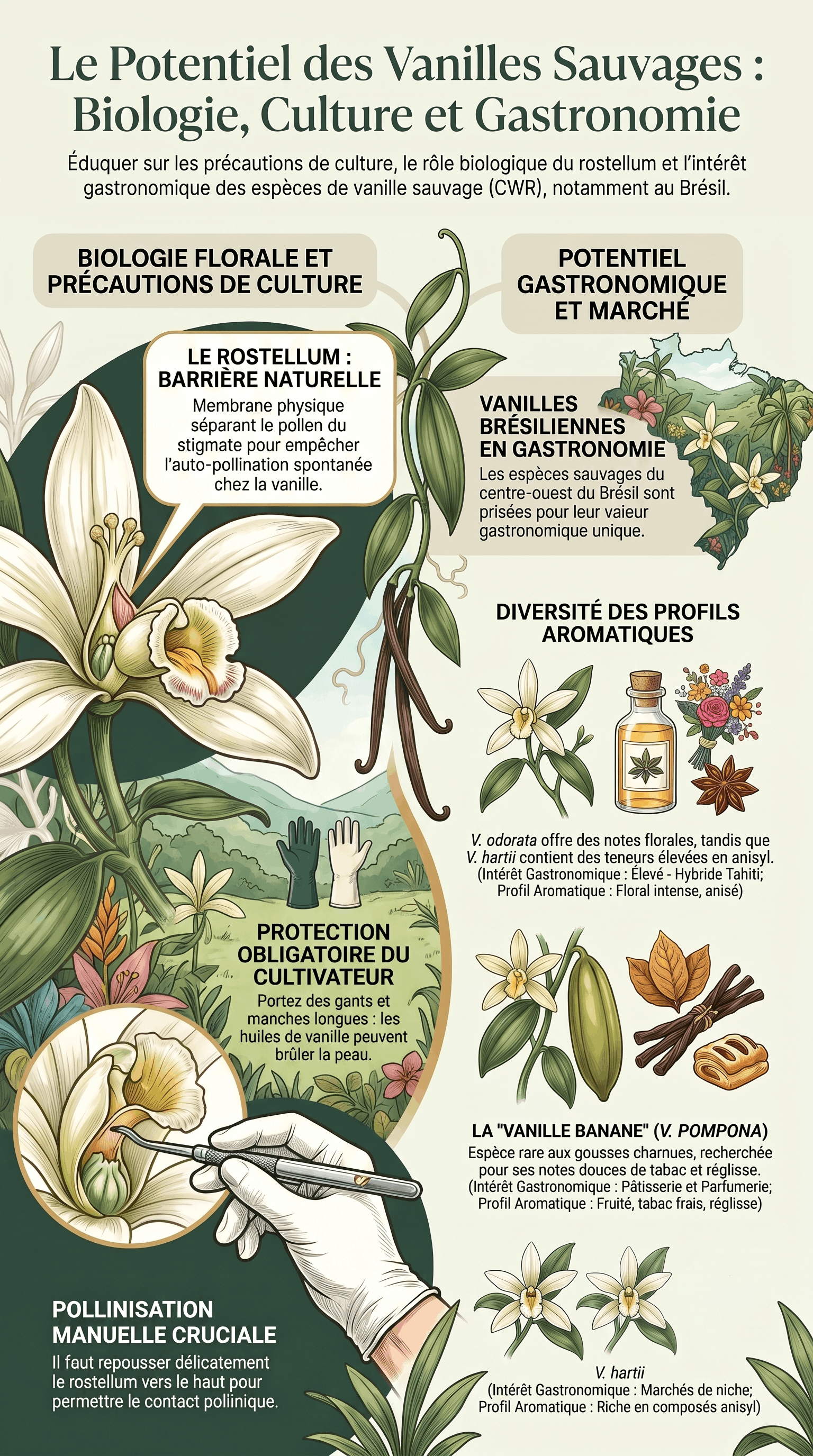
The odorata pod, fine, slender, and dehiscent, with a fragrance of legendary longevity.
What does its pod look like?
The odorata pod is finer and more slender than the Bourbon pod, measuring fifteen to twenty centimeters long and half a centimeter to a centimeter thick. Triangular in cross-section, it turns from bright green to a dark chocolate brown after curing, with a beautiful shine. It is less fleshy and pulpy than planifolia, but its black seeds are particularly large for an orchid.
An important technical point for producers: it is dehiscent. At full maturity, the pod splits open on its own along two sutures to release its seeds. This is its main cultivation constraint, as it must be harvested almost to the exact day before it opens and loses its commercial value. This is the exact flaw that Tahiti corrected by inheriting indehiscence.
What is its aromatic profile?
If I had to summarize odorata in one word, it would be "gourmand." Its scent is much sweeter, warmer, and denser than that of Bourbon. In the top notes, you find a floral and fruity hint tinged with licorice and sweet anise. Then comes a generous heart of honey, warm caramel, and freshly baked biscuit, with accents of gingerbread and shortbread. Finally, a balsamic and creamy base supported by rich, woody vanillin. It is the ultimate pastry vanilla, evoking dulce de leche and butter cookies.
Odorata vanilla olfactory pyramid
Top NotesFloral, fruity, licorice, sweet anise
Heart NotesHoney, warm caramel, biscuit, gingerbread
Base NotesBalsamic, creamy, woody vanillin
What does the pod analysis say?
The numbers hold a real surprise. Far from being a poor vanilla, odorata boasts an excellent vanillin content, measured at 1.7% free vanillin in wild populations in Costa Rica, and up to 3.2% dry matter in some selected crops in Ecuador, exceeding the Bourbon average. It also brings together a rare richness: gourmand phenolic derivatives like p-hydroxybenzaldehyde, responsible for the biscuit note, and anisic derivatives inherited through its relation to Tahiti.
Its fat fraction is also remarkable: oleic and linoleic acids alone account for over 82% of its fatty acids. These fatty acids act as natural aroma fixatives. They envelop volatile molecules and slow their evaporation. This is why odorata holds up exceptionally well when cooked, whereas Tahiti evaporates. And it contains no coumarin, so there are no usage restrictions.
How does it differ from other vanillas?
Odorata occupies a special place: it gathers a bit of strength from each of the major vanillas.
| Species | Profile | Vanillin | Heat Resistance |
|---|---|---|---|
| Vanilla odorata | Honey, caramel, biscuit, balsamic base & anise | Very high (1.7 to 3.2 %) | Excellent |
| Vanilla planifolia (Bourbon) | Classic, woody, creamy, camphorated | High (2.0 to 2.4 %) | Excellent |
| Vanilla x tahitensis (Tahiti) | Floral, anisic, cherry, plum | Low | Low |
| Vanilla pompona (Vanillon) | Floral, heavy, tobacco, licorice, coumarin | Very low | Medium |
How to use it in cooking?
This is where it truly shines. Thanks to its caramelized, biscuit notes and its excellent heat resistance, odorata is made for baked goods: pie crusts, shortbread cookies, crèmes brûlées, milk jams, dulce de leche, and premium ice creams. Where Tahitian vanilla would lose its soul in the oven, odorata keeps it intact. It pairs wonderfully with dark chocolate, re-creating the pre-Columbian blend, but also with coffee, caramel, pecans, and aged rum. Because its pod is thin, be sure to split it well and carefully scrape out its caviar of seeds.
The perfume that lasted thirty-six years.
The founding anecdote of this vanilla is astonishing. In 1826, botanist Presl described the species from pods brought back from a 1790 expedition in Ecuador. These pods, kept in cardboard boxes for thirty-six years, still gave off a powerful, intact fragrance. This legendary aromatic longevity remains one of the great signatures of odorata.
Arnaud's Opinion
I have a weakness for vanillas that tell a story of lineage, and odorata is one of them. It reminds us of a truth I have defended for fifteen years: world commercial vanilla relies on only a handful of wild genes, and behind every great vanilla hides an obscure forest orchid. Protecting odorata, classified as endangered since 2017, isn't just about saving a flavor; it's about protecting the genetic heritage of Tahitian vanilla itself.
Explore vanillas of the world
From the mother odorata to its Tahitian daughter, discover the entire secret genealogy of vanilla at our shop.
Discover our world vanillasFrequently Asked Questions
Why is odorata vanilla so little known?
Because it is almost never cultivated on an industrial scale: the global market is over 99% dominated by Bourbon and Tahiti. Classified as endangered, odorata remains a rare wild resource, reserved for fine dining and conservation projects.
What exactly is the link between odorata and Tahitian vanilla?
Odorata is the paternal parent of Tahitian vanilla, a hybrid born from its cross with Bourbon in Mayan gardens. It passed on its anisic notes and the indehiscence of its pods.
Does it withstand baking?
Very well, unlike Tahitian vanilla. Its fat fraction, over 82% rich in oleic and linoleic acids, acts as a natural fixative that slows the evaporation of its aroma even under heat.
Does it contain coumarin?
No, or only in negligible trace amounts. It therefore poses no risk and can be used freely, without the restrictions that apply to the pompona vanilla.
Can its pod be stored for a long time?
Remarkably well. Its aromatic compounds are renowned for their exceptional stability, as proven by Presl's historical sample, which was still fragrant after thirty-six years of storage.