Your cart
There are no more items in your cart
Key takeaways
- Recent discovery: Maya vanilla (Vanilla cribbiana) is a wild Central American orchid scientifically described only in 2010 by Soto Arenas & Phillip Cribb.
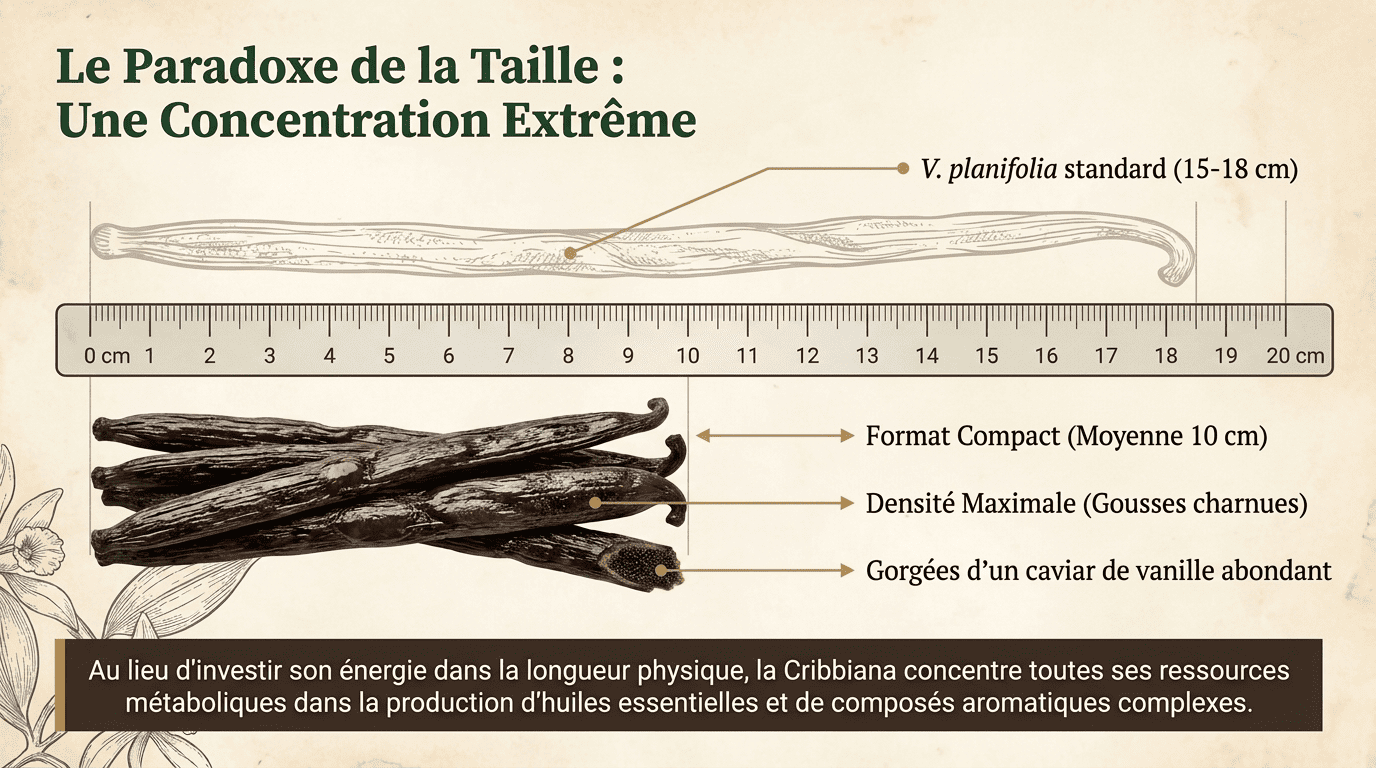
- Ultra-fatty pod: Its pods are short (6 to 16 cm) but boast an exceptional fat content of nearly 14%, the highest of the entire Vanilla genus.
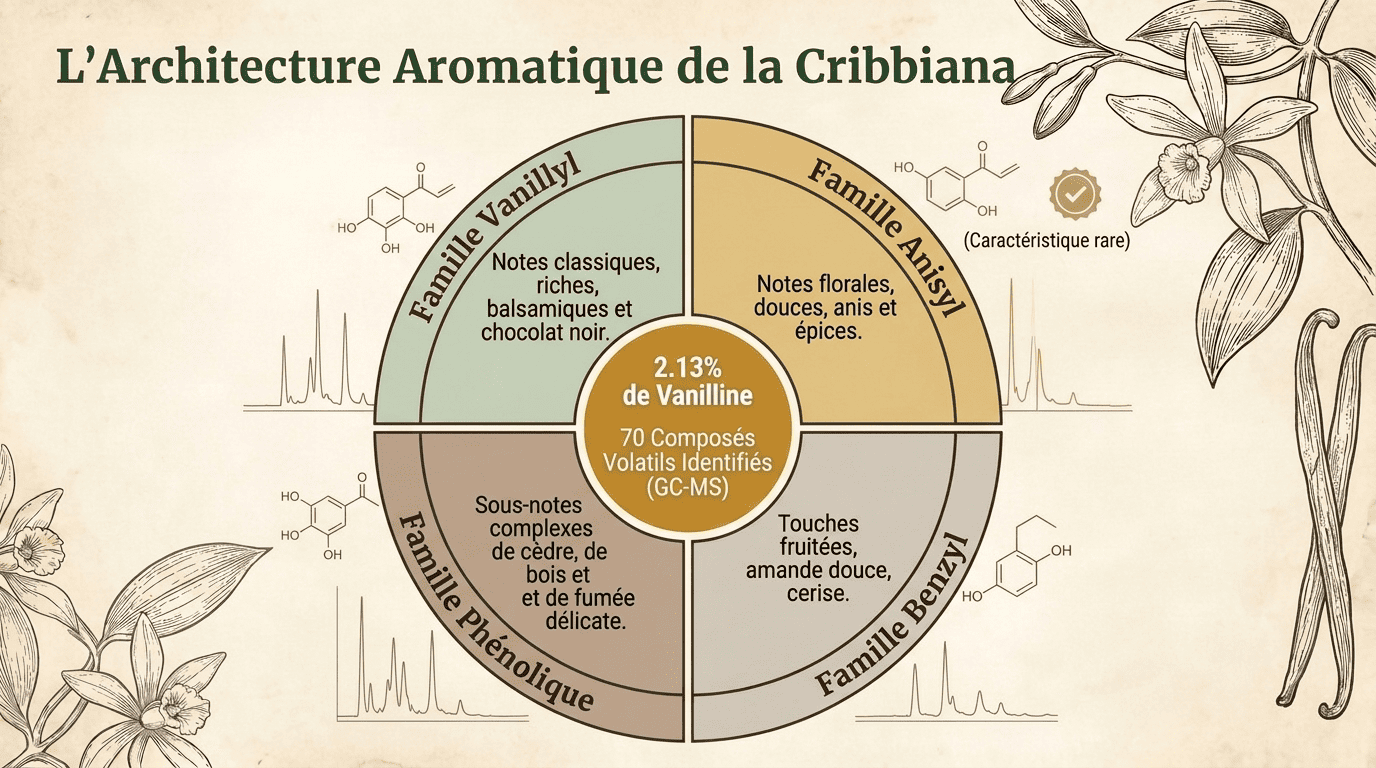
- High vanillin content: Around 2.13% pure vanillin, rivaling the best Bourbon beans from Madagascar.
- Aromatic profile: A gourmand and complex bouquet blending dark chocolate, mocha, caramel, cherry, sweet almond, and anise.
- Coumarin-free: Despite its notes reminiscent of the tonka bean, it contains no coumarin and can be used with no dosage restrictions.
There are vanillas we know by heart: Madagascar Bourbon, the highly floral Tahiti, the Caribbean pompona. And then there are beans that stop you in your tracks the first time you hold them. Maya vanilla is one of those. The first time I held one, I was surprised by two things at once: its small size, almost ridiculous next to a beautiful Madagascar bean, and its fatty, oily, sticky touch, as if the pod were sweating its perfume. It is a specialist's vanilla, so rare it's almost impossible to find, yet it alone tells the story of the hidden richness of the Vanilla genus.
What is Maya Vanilla (Vanilla cribbiana)?
Maya vanilla goes by the scientific name of Vanilla cribbiana Soto Arenas. It is a very recent species in the eyes of science: it was officially described only in 2010, by Mexican botanist Miguel Ángel Soto Arenas and British orchidologist Phillip Cribb of Kew Gardens, in the journal Lankesteriana. Before that, it was regularly confused in herbariums with the classic vanilla (Vanilla planifolia) or with Vanilla odorata. Its description thus helped unravel old botanical confusions in Central America.
Commercially, it is known under the names "Maya Vanilla" or "Flores Cribbiana". But its most moving name is the one given by the lowland Maya: Chesibik (sometimes written Sisbic or Zizbic). It is a vigorous, leafy, and branching hemiepiphytic vine, capable of climbing 8 to 12 meters along host trees, with thick, leathery, and brittle leaves. In short, a climbing orchid, a direct cousin to the ones that perfume our kitchens, but one that remained wild much longer.
Why does it grow at high altitude?
This is the first great secret of this vanilla. Where classic Bourbon loves hot tropical plains, between 0 and 600 meters, Maya vanilla adapted to the Mesoamerican highlands, between 600 and 1,200 meters of altitude, notably in the cloud forest of Cobán, Guatemala. And it literally drinks in this altitude into its scent.
In the mountains, the days are hot but the nights are cool. These cool temperatures, which would cause a planifolia to suffer or even die, only cause a mild thermal stress in the Maya vanilla. To protect itself, the orchid reacts by producing more oleoresins and protective aromatic compounds, which concentrate in the pod's tissues. This is one of the reasons it boasts one of the highest lipid contents of the entire Vanilla genus, nearly 14% of its dry matter.
Altitude also slows down ripening. Where a Bourbon pod ripens in 8 to 9 months, a Maya pod takes 9 to 11 months. This extra time allows the pod wall to synthesize and saturate its pulp with complex molecules of mocha, caramel, cherry, almond, and anise. Instead of expending its energy elongating, the plant concentrates everything in a small volume. The result is a true miniature aromatic bomb.
Maya vanilla (Vanilla cribbiana) observed during Le Comptoir's botanical research.
How do you recognize a cribbiana pod?
If you ever come across one, you won't confuse it with any other. Its pods are naturally short, between 6 and 16 cm, with an average around 10 cm. They are a very deep brown-black, extremely shiny, almost lacquered. Most importantly, they are thick, plump, chubby, and fleshy, with a triangular section, and are bursting with thousands of tiny seeds—that famous vanilla caviar.
But their signature is their touch. The Maya pod is fatty, oily, viscous, pliable, and moist under the fingers. This texture is not a flaw; it is the direct manifestation of its richness in aromatic oils. Where other vanillas dry out, it remains pliable and oozing with fragrance. Its thickness also makes it much easier to split open to scrape out the pulp.
What is its aromatic profile?
The bouquet of Maya vanilla is complex, powerful, and remarkably balanced. On the palate and nose, you first find a sweet vanilla, mocha, rich caramel, and an almost earthy dark chocolate. Then come finer notes of cherry, sweet almond, anise, and cedar wood. It is this encounter between the gourmand chocolate and the fruity anise that makes it so unique.
Maya vanilla olfactory pyramid
Top: Cherry, almond, anise, mint
Heart: Cinnamon, honey, pine, balsamic
Base: Dark chocolate, mocha, caramel, brown sugar
Heart: Cinnamon, honey, pine, balsamic
Base: Dark chocolate, mocha, caramel, brown sugar
A fascinating detail: this profile that sometimes evokes the tonka bean nonetheless contains no coumarin. The analysis of volatile compounds is definitive. These impressions of hay and heavy indulgence arise from a pure sensory synergy between vanillin, vanillic acid, and anise compounds, not a coumarin molecule. This is important because it means it can be used without the slightest dosage restriction, unlike the tonka bean.
What does the pod analysis say?
The numbers confirm everything the tasting reveals. A 5 kg batch of Maya vanilla cured in Cobán was analyzed in a laboratory, and the results speak volumes.
| Parameter | Value (dry matter) | What it means |
|---|---|---|
| Vanillin | approx. 2.13% | On par with the best Bourbons, despite a small pod |
| Lipid fraction | approx. 13.96% | Highest in the genus, hence the oily touch |
| Oleic acid | approx. 53% of fatty acids | A smooth, liquid oil that carries the aromas |
| Linoleic acid | approx. 29% | Over 82% unsaturated fatty acids in total |
| Anisic acid | present | Absent in Bourbon, marker of its floral complexity |
| Coumarin & heliotropin | absent | Free usage, no dosage restrictions |
What is striking is this dual personality: a vanillin content worthy of a great cooking vanilla, coupled with an extraordinary fat fraction that acts as a perfume reservoir. The pod is also very fibrous, which explains its hardiness, and the absence of detectable glucovanillin shows that its aromatic precursors were fully transformed during curing.
How does it differ from Bourbon, Tahiti, and Pompona?
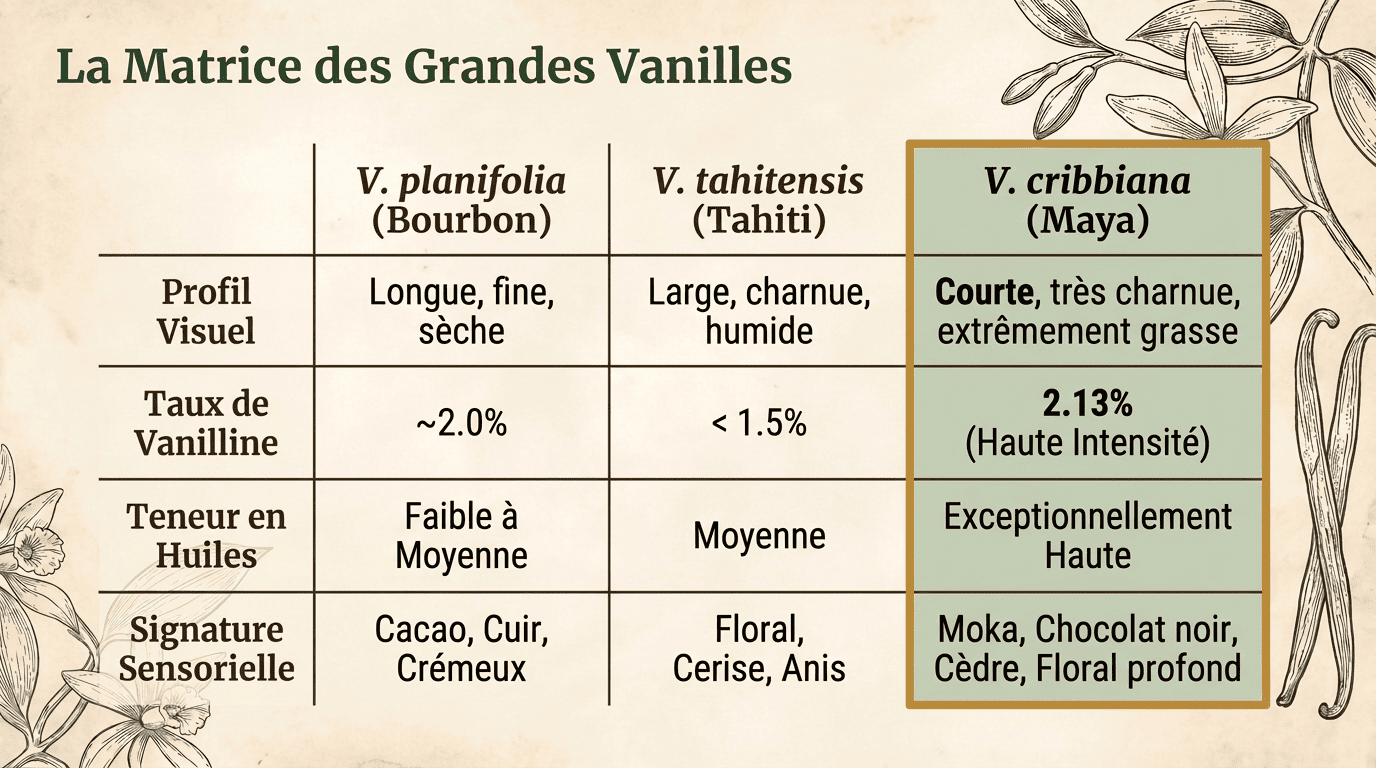
To truly grasp Maya vanilla, nothing beats a comparison with the three vanillas everyone knows. Bourbon (Madagascar vanilla) offers a straightforward, woody, and warm profile, dominated by vanillin, perfect for baking. Tahitian vanilla is all flowers and anise, but lower in vanillin and fragile to heat. Pompona (Vanilla pompona, or vanillon) is buttery and balsamic, but very low in vanillin.
The Maya vanilla achieves a rare synthesis: the vanilla power of Bourbon, some of the fruity anise of Tahiti, and a fatty unctuousness even greater than that of pompona.
| Species | Key Origin | Vanillin Rate | Major characteristic |
|---|---|---|---|
| Vanilla cribbiana (Maya) | Guatemala / Mexico | ~ 2.13% | Lipid record (~14%), oily pod, chocolate/mocha/anise notes |
| Vanilla planifolia (Bourbon) | Madagascar / Mexico | ~ 1.8 to 2.4% | World reference, woody, caramelized, and warm profile |
| Vanilla tahitensis (Tahiti) | Tahiti / Papua N.G. | ~ 0.8 to 1.2% | Anisic, floral, fleshy indehiscent pod |
| Vanilla pompona (Vanillon) | Caribbean / Central America | ~ 0.4 to 0.7% | Giant "banana" pod, balsamic notes |
Vanillas of the World Masterclass: the short, fleshy, and extremely oily pod of Vanilla cribbiana.
How is it pollinated, harvested, and cured?
It is often said that the small stingless bees of the genus Melipona pollinate Central American vanillas. It's a nice story, but recent science corrects it. The Melipona do visit the flowers, but they are simply too small to accomplish the demanding mechanics of the flower. To fertilize a vanilla flower, the insect must lift the rostellum—the membrane separating the male organ from the female organ—by applying genuine pressure. Melipona have neither the size nor the strength for this, and mostly behave as simple pollen thieves.
The true pollinators of Maya vanilla are large orchid bees of the Euglossini tribe, especially the genus Eulaema. Males are attracted by the flower's powerful fragrant compounds, which they collect for their mating displays. Their robust bodies perfectly fit the floral tube, and as they back out, they take the pollinia glued to their thorax. Because these large bees are becoming scarce in degraded forests, the natural fertilization rate drops to less than 1 to 5%. In cultivation, humans must therefore pollinate by hand, flower by flower, at dawn, during the short window when the flower remains open.
Traditional Maya curing takes about three months. Green pods are briefly scalded, sweated under wool blankets in warm wooden boxes, then alternate for two months between short sun exposures and sweating nights, before resting for a month in wooden boxes to stabilize moisture and concentrate oils. You don't look for the yellowing of the tip as you do for Bourbon, but rather a slight softening of the pod, a sign that its fat fraction is at its peak.
How to use it in cooking?
Its unique richness in fats makes it the absolute ally of all fatty mediums. Maya aromas dissolve and diffuse beautifully in crème anglaise, panna cottas, ice cream bases, dark chocolate ganaches, and puff pastry butter. Heated, a gentle infusion in milk or cream releases its chocolate and balsamic notes. Cold, by maceration, its floral cherry and anise notes are better preserved.
For spirits, it is superb with a neutral vodka, which acts as a blank canvas and lets its anisic notes speak, but also with aged rum, bourbon, brandy, or cognac for warmer pairings.
Arnaud's tip: instant vanilla sugar.
Never throw away the sachet or jar that held your Maya beans: their walls retain a wildly fragrant film of oil. Pour in one to two cups of white sugar, shake vigorously, and let rest for three to five days. The porous crystals absorb the oil and you get vanilla sugar of incredible intensity, with notes of black cherry and mocha. It is the favorite zero-waste trick for lovers of fatty vanilla.
Who saved it from oblivion?
This is perhaps the most beautiful part of the story. In pre-Columbian times, wild Chesibik vanilla formed, along with cacao and annatto (roucou), the sacred triad of the lowland Maya. Crushed together on flat stones, these three ingredients yielded a bitter and fatty chocolate paste, served as a ritual drink, tribute, and even currency. Then, with the collapse of classic trade networks, the use of this particular vanilla fell into oblivion for nearly four centuries.
Its modern salvation is owed to one man, Dario Ramirez Fontana, a former Guatemalan rodeo champion. During an international vanilla symposium in Papantla, he attended a lecture on the rediscovery of cribbiana and its extraordinary aromas. Captivated, he decided to track down this wild vine on his own cloud forest lands in Alta Verapaz. After years of exploration and patient cutting propagation, he founded a pioneering plantation in Cobán, with some 15,000 vines cultivated under canopy. Today, he is virtually the only one commercializing this historic Maya vanilla, while also providing sustainable income to local communities.
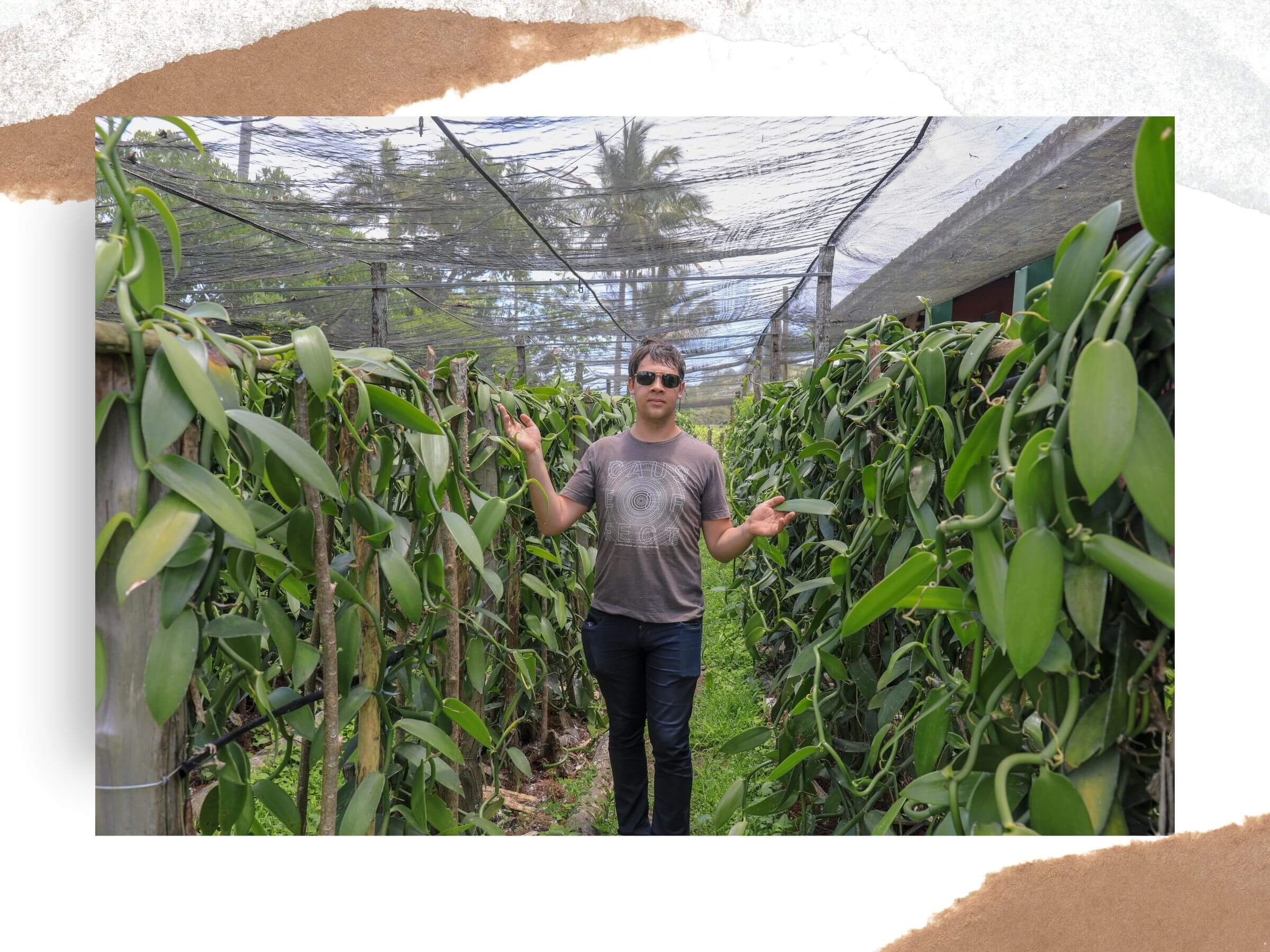
Presentation and analysis of wild Maya vanilla by Arnaud Vanille (Arnaud Sion).
Arnaud's Opinion
I don't sell dreams: Maya vanilla is not an everyday vanilla, and it will never replace your Madagascar bean for a family custard. It is an emotional vanilla, to bring out for a festive ganache or a chef's ice cream. What touches me is that it proves something I have been repeating for fifteen years: the vanilla world is not limited to three species. Behind the Bourbon, there is immense biodiversity, fragile, often threatened, that deserves to be tasted, talked about, and protected.
Pre-Columbian EraUse of Chesibik vanilla by the Maya along with cacao and annatto in sacred drinks.
16th - 20th CenturyAfter the Spanish conquest, the use of this wild high-altitude vine fell into oblivion for 400 years.
2010Official scientific description of Vanilla cribbiana by Soto Arenas & Phillip Cribb in the journal Lankesteriana.
TodayRescue and pioneering canopy cultivation by Dario Ramirez Fontana in Cobán (Guatemala).
The sacred hot chocolate of the Maya triad
A modern reinterpretation of the Maya drink, reuniting cacao, annatto, and Maya vanilla. The phenolic molecules of cribbiana, mocha and chocolate, harmonize with cacao polyphenols, while its oils rich in oleic acid integrate with cocoa butter for a rare creaminess.
Ingredients (for 2 cups)
- 350 ml whole milk
- 120 g 70% dark couverture chocolate
- 1 Maya vanilla bean (Vanilla cribbiana)
- 1 pinch finely ground annatto seeds (roucou)
- 1 tsp honey
- 1 pinch sea salt
Preparation (15 min)
- Finely chop the couverture chocolate.
- In a saucepan, pour the milk, ground annatto, and honey.
- Split the Maya pod, scrape out the seeds, and add them to the milk along with the cut pod.
- Gently bring to a simmer, then steep over very low heat for 10 minutes without boiling.
- Remove from heat and strain to remove the spent pod.
- Pour the chopped chocolate and salt into the hot milk, wait a minute, then whisk vigorously until a dense, creamy foam forms.
- Serve hot. The nose immediately reveals the mocha, coffee, and forest caramel of this wild vanilla.
Explore vanillas of the world
Beyond Bourbon, a whole universe of rare beans awaits you at the shop.
Frequently Asked Questions
Why are Maya vanilla pods so short?
It's a genetic trait of this neotropical species, which naturally produces smaller flowers and capsules, reinforced by its adaptation to cool highlands, where a compact fruit ripens more evenly.
Why are they so fatty and sticky to the touch?
Because they contain nearly 14% fat in dry matter, primarily liquid oleic acid, secreted by a high density of specialized cells in the pod walls.
Is such a small vanilla less intense than a Bourbon?
On the contrary. It contains about 2.13% vanillin, matching the best Bourbons, and concentrates an immense aromatic diversity in its abundant oils. It's a true concentrated flavor bomb.
Is it threatened with extinction?
Yes. It is classified as critically endangered on Belize's official list and is among the top priority wild crop relatives for conservation against climate change. Its sustainable cultivation is also a tool for preservation.
Can it be used without precaution despite its tonka notes?
Yes. Its profile evokes tonka bean, but it contains no coumarin. It can therefore be used freely, without the dosage restrictions that apply to tonka.