Your cart
There are no more items in your cart
Key takeaways
- The universal queen: Vanilla planifolia represents about 95% of the vanilla consumed in the world and sets the standard for vanilla flavor.
- Born in Mexico: domesticated by the Totonacs in Papantla, it was the sacred tribute of the Aztecs, the tlilxóchitl or black flower.
- The richest in vanillin: from 1.5 to 3.6% of dry matter, giving it its warm, creamy, and caramelized profile.
- "Bourbon" is not a species: it is the geographical designation for planifolia grown in the Indian Ocean, led by Madagascar.
- The champion of baking: its aromas perfectly withstand heat, making it the ultimate pastry vanilla.
If I had to keep just one vanilla, it would be this one. Not because it is the easy choice, but out of loyalty. Planifolia vanilla is the one that launched my life as a spice hunter, the one I first went to see in Madagascar in 2010, the one that flavors the custards of our childhood. It is quite simply the queen, yet few people truly know its history, its chemistry, and its terroirs. Here is the complete portrait of the most famous vanilla.
What is planifolia vanilla?
Planifolia vanilla bears the scientific name Vanilla planifolia, described in 1808 by British botanist Henry Charles Andrews. It is the one we simply call "vanilla," but also Bourbon vanilla or Madagascar vanilla depending on its terroir. It belongs to the orchid family, the largest family of flowering plants in the world, and it is even the type species—the one that serves as the reference for the entire Vanilla genus.
It is a climbing, fleshy, and vigorous vine capable of reaching thirty meters in length in its original forest habitat. It takes root in the ground, then clings to host trees using its aerial roots to climb toward the light. Its greenish-yellow flower opens for only one morning. After this brief moment, if it has not been pollinated, it falls off. The entire history of vanilla lies in the difficulty of pollinating this ephemeral flower.
Where does it come from and why is Mexico its cradle?
Planifolia is native to the tropical forests of Central America, and its center of domestication is in Papantla, in the state of Veracruz, Mexico. The Totonacs were the first to cultivate it, long before the Aztecs. The Aztecs, upon conquering their territory, made it a precious tribute and called it tlilxóchitl, the black flower, in reference to the dark color the pod takes on once dried. They mixed it with cacao in a sacred drink reserved for emperors and warriors.
Today, in a paradox of history, Mexico accounts for only about 6% of global production. The queen has emigrated. Madagascar now supplies the overwhelming majority, primarily from its SAVA region (Sambava, Antalaha, Vohémar, Andapa), alone capturing more than half of the spice's global value. Then comes Indonesia, Uganda, Papua New Guinea, and a few others. But all cultivate the same species born in Mexico.
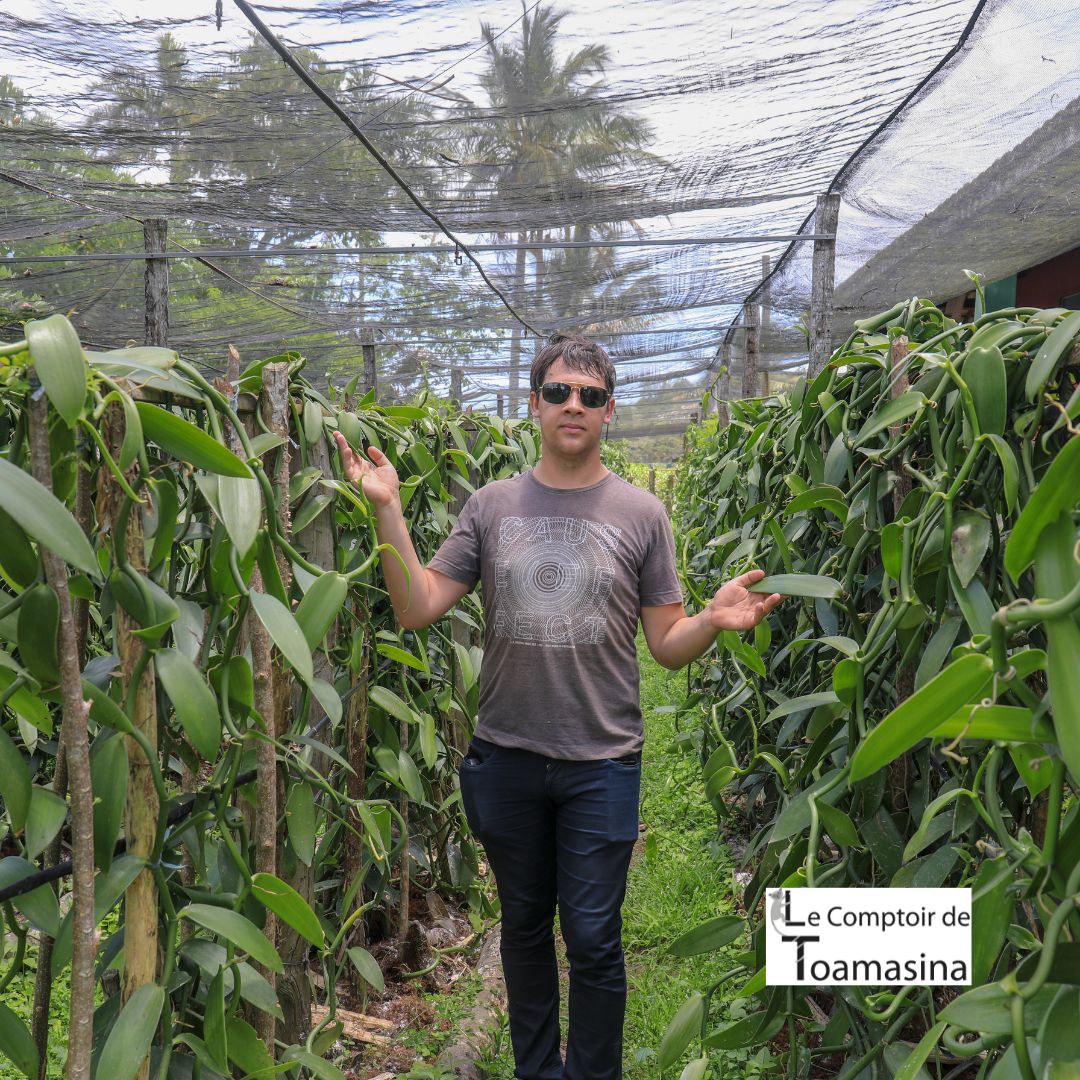
The Vanilla planifolia vine in its prime terroir, the SAVA region in Madagascar.
Why isn't "Bourbon" a species name?
This is a very common confusion, and I want to clear it up entirely. Bourbon vanilla is not a different botanical species from planifolia: it is the exact same plant. Bourbon is a geographical and historical designation of origin reserved for Vanilla planifolia grown and prepared in the southwestern Indian Ocean, namely Madagascar, Reunion Island, Comoros, Mauritius, and Seychelles. Reunion Island was formerly called Bourbon Island, hence the name.
A pod of the same species grown in Mexico or Uganda cannot, therefore, be called Bourbon, even if its plant is genetically identical. It is a matter of terroir and know-how, exactly like a fine wine. The Madagascar vanilla that I select is thus a Bourbon vanilla, the most famous representative of the species.
What is its aromatic profile?
Planifolia is the absolute global standard for vanilla flavor, the one that all others attempt to imitate. Its bouquet is warm, rich, intensely sweet, and perfectly balanced. The top notes are a slightly fruity and almond-like freshness. The heart is pure vanilla in all its indulgence: creamy, milky, caramelized. The base offers a balsamic, woody, and resinous depth, featuring those famous chocolate and cacao notes that are its signature.
Planifolia vanilla olfactory pyramid
Top NotesFresh, fruity, sweet almond
Heart NotesCreamy, milky, caramel vanilla
Base NotesBalsamic, woody, chocolate, cacao
A detail I love explaining: these chocolate notes are not added; they are born during the curing process. During the "sweating" phase, the pod develops specific molecules—biphenyl derivatives—that amplify the sensation of fat and creaminess in the mouth, perfectly mimicking the velvety texture of cocoa butter. Vanilla does not contain chocolate; it manufactures the illusion of chocolate. That is high natural chemistry.
Why does each terroir produce a different vanilla?
This is what excites me the most. The same species, grown under different skies, never yields exactly the same flavor. This is the very principle of terroir, and planifolia expresses it beautifully.
| Terroir | Aromatic Profile | Character |
|---|---|---|
| Madagascar (SAVA) | Sweet, creamy, chocolatey, balanced | The global benchmark for vanilla |
| Mexico (Papantla) | Complex, herbaceous, woody, spicy | The original, wild profile |
| Indonesia | Robust, woody, smoky, phenolic, tobacco | Most heat-stable, less sweet |
| Uganda | Rich, fatty, earthy, deep cacao | An exceptional African terroir |
| Vanuatu / Pacific | Spicy-sweet, full, balsamic | Intense volcanic soils |
Compared to planifolia, the other major vanillas occupy different registers: Tahitian vanilla is more floral and anisic but fragile to heat, and pompona (Vanilla pompona) is more herbaceous and reserved mostly for perfumery. Planifolia remains the only one to combine high vanillin content, a rounded profile, and perfect resistance to cooking.
What does the pod analysis say?
The numbers explain its dominance. Its vanillin content is exceptionally high, ranging from 1.5 to 3.6% of the dry matter depending on the batch and terroir, far ahead of other vanillas. Its pod contains over 250 aromatic and phenolic compounds, including vanillic acid, p-hydroxybenzaldehyde, and guaiacol. An important fact for consumer confidence: healthy planifolia never naturally contains coumarin. The presence of coumarin in a commercial extract is, on the contrary, a sign of fraudulent adulteration with low-quality synthetic vanillin.
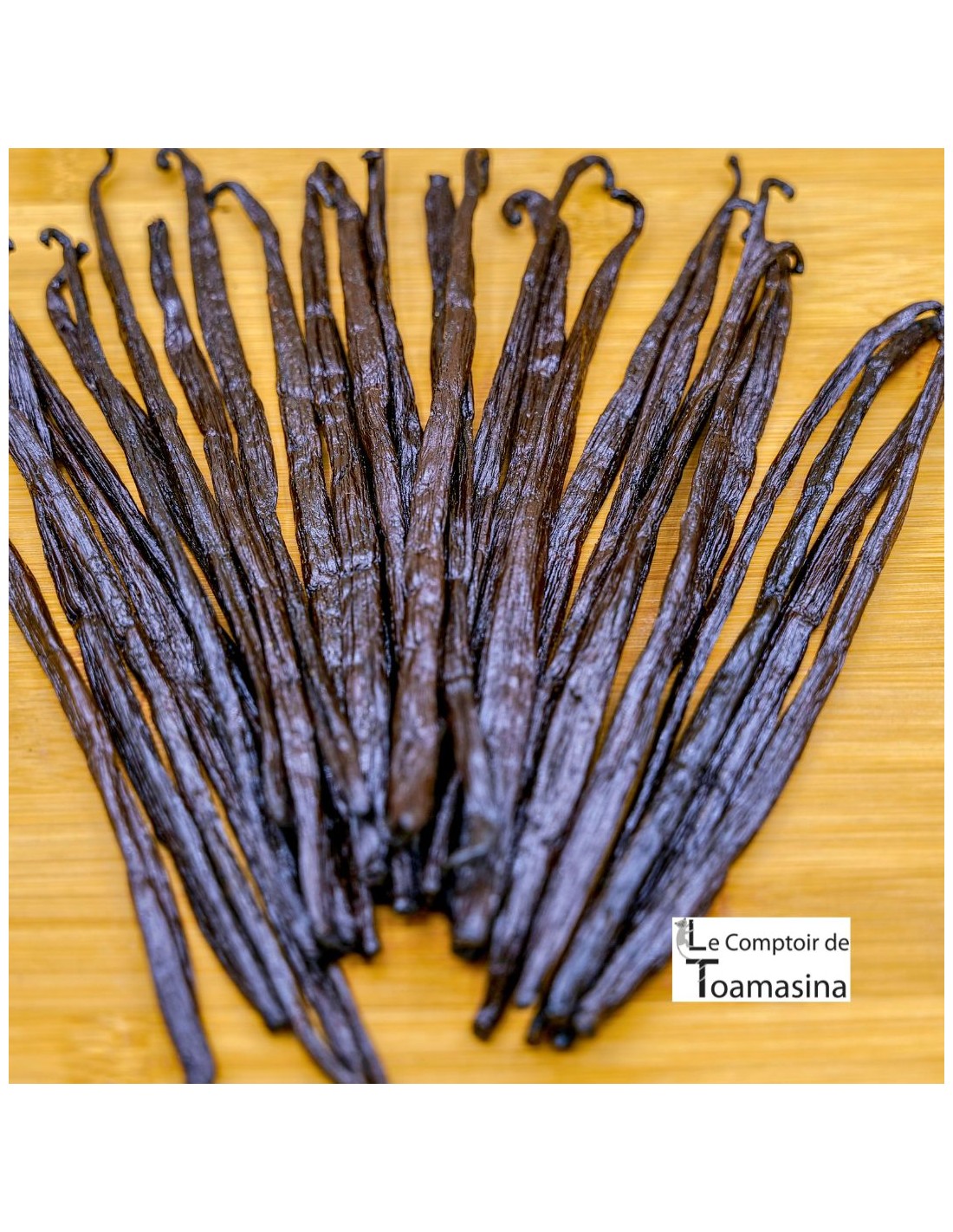
Planifolia pods (here from Papua New Guinea): long, thin, and bursting with vanillin.
How is green vanilla prepared?
This is the great secret of vanilla, and a revelation to many: the green, freshly picked pod is completely odorless. Its entire fragrance is born from the preparation, which is called curing. The so-called Bourbon method consists of four main stages. First, scalding, a hot water bath between 65 and 75 degrees Celsius that kills the plant life and triggers enzymatic reactions. Next is sweating, where the pods perspire under wool blankets and take on their chocolate-brown color. Then comes slow drying, alternating between sun and shade for several weeks. Finally, the maturing (affinage) in wooden trunks, lasting from two to twelve months, sometimes up to two years, which concentrates and rounds out the aromas.
A myth to correct: scalding was not invented in Madagascar.
Many are unaware, but the hot-water scalding process that forms the foundation of the Bourbon method was developed on Reunion Island (formerly Bourbon Island) in the nineteenth century. It was French settlers and technicians who later transferred it to Madagascar at the end of the nineteenth century. The Malagasy people adopted it, perfected it, and brought it to an industrial scale that established the global reputation of the SAVA region. Madagascar elevated the method, but did not invent it.
How to use it in cooking?
Planifolia is the ultimate cooking vanilla. Its remarkable thermal stability allows it to withstand long infusions and the high heat of an oven without losing its soul. It is essential in crèmes brûlées, custards and pastry creams, flans, soufflés, chocolate ganaches, and ice creams. It is best used hot, infused into milk, cream, or butter, which dissolves its fatty pulp and releases all its aromas. It pairs beautifully with chocolate, caramel, coffee, autumn fruits, and exotic fruits, and works wonders in savory dishes with white fish or scallops.
From Charles Morren to Edmond Albius: the gesture that changed everything
For over a century, Europe grew vanilla in its greenhouses without ever obtaining a single pod. The vines grew and flowered, but remained sterile. The reason was only understood later: the flower has a membrane, the rostellum, which separates the male organ from the female organ and prevents self-pollination. In the wild in Mexico, only certain native bees knew how to bypass this barrier.
In 1836, in Liège, Belgian botanist Charles Morren performed the first documented artificial pollination. But his method, done under a microscope, took nearly twenty minutes per flower—useless on a large scale. The solution came from elsewhere, and from the most unexpected of hands.
In 1841, on Reunion Island, a twelve-year-old orphaned slave, Edmond Albius, discovered the simple, rapid gesture that would change the world. Using a sliver of bamboo, he lifted the rostellum and pressed the anther against the stigma with a simple push of his thumb. A few seconds, over 90% success. This gesture is still the one reproduced by all SAVA planters today, every morning, flower after flower. Edmond Albius brought fortune to Reunion Island and later to Madagascar, yet died poor and forgotten in 1880. Behind every Bourbon pod, there is this child.
Arnaud's Opinion
Planifolia is not the rarest vanilla, nor the most exotic. It is simply the most accurate, the most reliable, the most universal. It is the one I recommend to everyone, from the Sunday cook to the Michelin-starred chef, because it never betrays you. But behind its apparent commonness lies an immense history: an enslaved child, chemistry that invents the taste of chocolate, and a Malagasy terroir that I have championed for fifteen years. To respect it is to refuse synthetic vanillin and choose the real pod—the one that required nine months of patience and Albius's touch.
Before the 16th centuryDomestication of vanilla by the Totonacs in Papantla, later becoming the sacred tribute of the Aztecs.
Around 1520Introduction to Europe by Spanish conquistadors, along with chocolate.
1808Scientific description of the species by Henry Charles Andrews.
1836First documented artificial pollination by Charles Morren in Liège.
1841Edmond Albius invents rapid hand-pollination on Reunion Island.
TodayMadagascar dominates the global market, with planifolia accounting for around 95% of vanilla consumed.
Discover our planifolia vanilla
From Madagascar Bourbon to vanillas around the world, explore our selection of cured pods, chosen one by one.
Frequently Asked Questions
Are Bourbon vanilla and planifolia vanilla the same thing?
Yes. Bourbon is not a species but a geographical designation of origin for Vanilla planifolia grown in the Indian Ocean (Madagascar, Reunion Island, Comoros). The plant is the same; only the terroir changes.
Why does planifolia vanilla withstand cooking so well?
Thanks to its high vanillin content and heat-stable base compounds. Unlike Tahitian vanilla, whose floral notes are volatile, planifolia retains its aroma during long infusions and oven baking.
Does vanilla contain coumarin?
No, healthy Vanilla planifolia never naturally contains it. The presence of coumarin in an extract is, in fact, a sign of fraudulent adulteration with low-quality synthetic vanillin.
Why is vanilla so expensive?
Because its cultivation is one of the most demanding in the world: hand-pollination flower by flower, nine months of maturation, then months of curing. Add to this the concentration of production in Madagascar and its vulnerability to cyclones, which causes prices to soar.
Who made the global cultivation of vanilla possible?
Edmond Albius, a twelve-year-old slave from Reunion Island, who invented the rapid hand-pollination technique in 1841 that is still used today. Without him, vanilla would have remained an exclusive Mexican product.