Gunpowder Green Tea
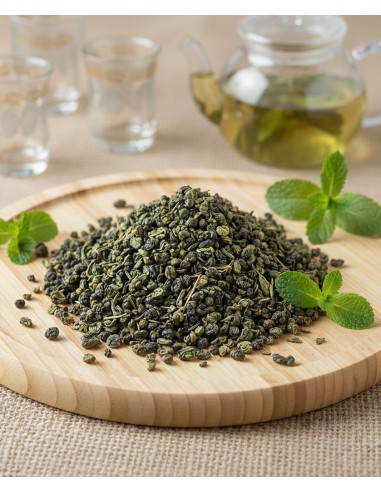
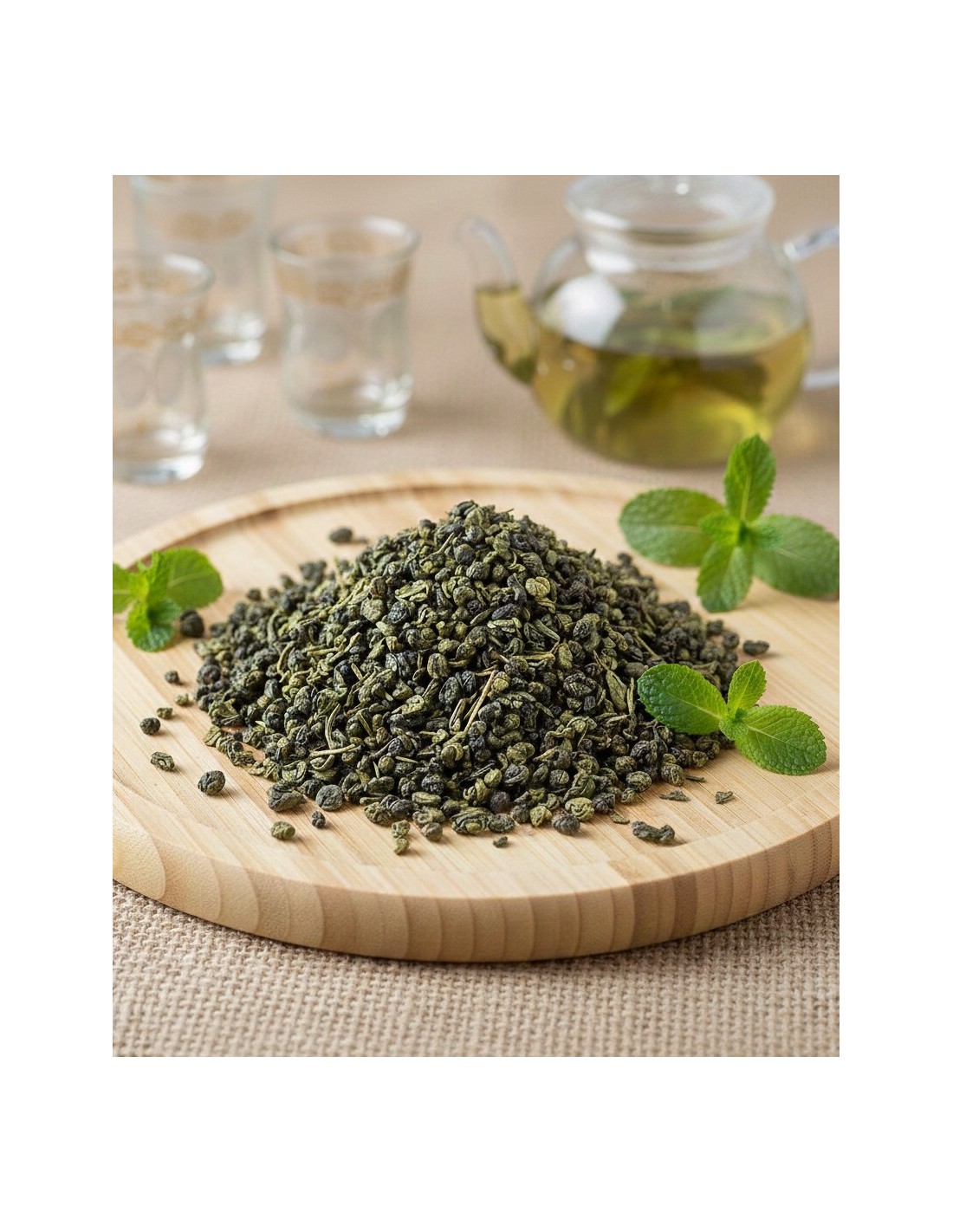
Gunpowder Green Tea. Leaves rolled into small, shiny, and tight pearls (known as "gunpowder"). The tea is impressive for its freshness with a vegetal fragrance, a full-bodied and slightly smoky taste giving way to a golden, thirst-quenching liquor.
-
Main notes: Vegetal and slightly smoky notes giving way to an intense and lingering freshness.
-
Leaves: Rolled into tight pearls (Temple of Heaven).
-
Aromatic Profile: The star of mint tea. A tea with a powerful and robust character, the most famous of green teas.
Discover a green tea with character, the pillar of Moroccan tradition. Buy an authentic tea with the best quality-price ratio. A truly convivial tea!
Gunpowder Green Tea
珠茶 Zhu Cha
"Le Comptoir de Toamasina offers you Gunpowder green tea. A unique tea leaf, a recognizable Gunpowder chosen by Arnaud for its tight pearls and aromatic power."
A unique tea leaf
A Gunpowder recognizable by its leaves rolled into small, shiny, and compact pellets that blossom in water.
Power and Character
A tea with full-bodied, slightly smoky, and very refreshing notes. A golden-yellow liquor and a frank taste.
Versatility
The absolute base for traditional mint tea, but also excellent plain for an invigorating wake-up.
It is the essential tea for the mint tea ceremony. Although this tea is most famous in North Africa for preparing mint tea, it originated in China, where its history dates back to the prestigious Tang Dynasty (618-907). We offer you here a superior quality that guarantees an infusion without excessive bitterness if properly prepared.
Known by its original name Zhu Cha (珠茶, literally "pearl tea") in China, it is one of the oldest and most consumed green tea styles around the world. Its leaves are meticulously rolled up on themselves to form small, dense pearls of a dark and shiny olive green. This traditional rolling process, which initially served to preserve the freshness of the leaves and facilitate their transport over long distances without degradation, now allows it to offer an infusion of incomparable power and freshness.
Comparative Sensory Analysis
Gunpowder vs Chun Mee vs Sencha
The pearl-rolled tea facing its roasted and steamed cousins
The most robust of the three: the tight rolling into pearls traps the essential oils and gives Gunpowder a more intense and textured body than the majority of traditional green teas like Sencha or Chun Mee. It is this same robustness that makes it uniquely capable of withstanding direct decoction on the fire for mint tea.
Gunpowder · Chun Mee · Sencha
The Olfactory Pyramid of Gunpowder
What the pearl reveals once unfolded in hot water
Technical Sheet
What You Receive
- Country of OriginChina
- Botanical SpeciesCamellia Sinensis
- IngredientsGunpowder Green Tea
- Main NotesFull-bodied, slightly smoky
- To be enjoyedMorning and afternoon
- AllergenNone
- Possible TracesNone
- PackagingPouch or Tin
- LogisticsPrepared within 24h - Delivered within 48h
The origin: why "gunpowder"?
The name of this tea is fascinating and is explained by several well-documented theories:
Four explanations, one English origin
The visual resemblance — this is the most recognized theory. In the 17th century, British merchants of the East India Company noticed that the highly compressed little gray-green pearls bore a striking resemblance to the grains of black powder used for artillery at the time.
The leaf "explosion" — upon contact with hot water, the rolled leaves suddenly unfurl in a rapid expansion movement, reminiscent of the detonation of gunpowder.
Phonetic distortion — a likely linguistic explanation suggests that "Gunpowder" comes from a phonetic misinterpretation of the Mandarin phrase "gang pao de" (刚泡的), which literally means "freshly brewed".
The Arabic translation — in Maghreb countries, the tea is often translated by the term barūd ("gunpowder") or lamkarkab ("the rolled one").
What is Gunpowder tea
Gunpowder is a green tea from China whose leaves are dried and then rolled very tightly upon themselves. This ancestral technique was initially intended to better preserve the tea during long sea voyages. The smaller and shinier the pellets, the younger and higher quality the tea. Conversely, large, open pellets often indicate a lower quality tea.
Production: precise know-how in 5 steps
- Plucking: for higher qualities, the most tender spring shoots are hand-selected; later, more mature summer harvests are destined for standard grades.
- Withering: the fresh leaves are spread out for 12 to 17 hours to reduce their water content to 60-70%, making them pliable for rolling.
- Thermal fixation: the leaves are dry-roasted in a rotating drum or metal wok to stop oxidation—this dry roasting gives Gunpowder its characteristic grilled and toasted notes.
- Rolling: the key step. The still-hot leaves are rolled into tight little pearls that trap the essential oils.
- Drying and sorting: the pearls are oven-dried to 3-5% residual moisture, permanently fixing their spherical shape, then sorted by size to determine the final grade.
Sensory profile and why do my leaves open
The infusion offers a limpid liquor ranging from pale yellow to bright golden-green. On the nose, marked scents of fresh cut grass, supported by subtle aromas of hazelnut, roasted chestnut, and a delicate touch of smoke. On the palate, a robust and structured body, considerably more intense and textured than most traditional green teas. The astringency is present but well-controlled, complemented by a mineral, vegetal, and slightly sweet finish with honey notes.
Gunpowder is an economical tea because its leaves unfold enormously: a small amount is enough for a lot of volume. Why do your leaves open in hot water? It's the sign of quality! The "pearl" simply resumes its original leaf shape—the physical kinetics of the pearl is in fact spectacular, unfurling suddenly on contact with hot water.
How to prepare and steep Gunpowder Green Tea
Gunpowder is more robust than Sencha. It withstands hotter water, but requires specific preparation, especially for mint tea. Unlike Sencha, Gunpowder often needs to be "washed" before steeping.
1. The traditional method (mint tea)
This is the king method for this tea.
- Proportion: 1 good tablespoon of Gunpowder for 1 liter of water.
- The washing (crucial): put the tea in the teapot, pour a glass of boiling water, swirl the teapot, then discard this water—this rinses the tea and removes excess bitterness. Keep the damp leaves at the bottom.
- Preparation: add a bunch of fresh mint and sugar on top of the rinsed leaves.
- Steeping: fill with boiling water (90-95°C). Let steep for 3 to 5 minutes.
- Serving: pour a glass, put it back in the teapot. Repeat to mix the sugar. Serve by raising the teapot high to "froth" the tea.
2. The Western method (plain)
To appreciate its full-bodied taste without sugar: dosage of 12g per liter (or 2g for a 200ml cup), temperature of 80°C to 85°C—never boiling water, at the risk of scalding the leaves—and time of 2 to 3 minutes maximum, beyond which it becomes very astringent. A shorter time of 1 to 1:30 minimizes astringency. Quality pearls can be re-steeped 3 to 5 times, increasing the time by 30 seconds at each step.
Cold brew infusion
For a summer drink: 2 to 3 tablespoons of pearls in 400ml of cold water, in the refrigerator for 8 to 10 hours. Serve ice-cold with a slice of lemon or mint.
The Moroccan mint tea ritual (Atay)
Throughout the Maghreb, Gunpowder tea is the central and inseparable element of mint tea, the absolute symbol of hospitality and social sharing. Its robust structure and slight bitterness allow it to withstand direct decoction on the fire and perfectly balance the sweetness of the sugar and the power of the fresh mint without fading away.
The essential ingredients (for 4 to 6 people)
- Tea: 1 to 2 tablespoons of Gunpowder.
- Mint: 1 large bunch of fresh mint, ideally Nana variety (embossed leaves, sweet and pronounced scent).
- Sugar: about 4 to 6 tablespoons of white sugar, depending on the traditional sweet taste.
- Water: 1 liter of filtered or spring water.
- Optional: a few drops of orange blossom water or lemon verbena (lwiza).
The step-by-step recipe (traditional decoction method)
- 1. Extracting the spirit of the tea (rouh): place the tea at the bottom of the teapot (berrad). Pour half a glass of boiling water, let steep for 10 to 15 seconds without stirring. Pour this first amber liquid into a glass and keep it safely—it's "the spirit of the tea".
- 2. The purification rinse: pour a second glass of boiling water over the leaves left at the bottom, swirl the teapot vigorously then discard this liquid. This step removes dust and the most bitter surface tannins.
- 3. Decoction and caramelization: reintroduce the saved spirit of the tea, fill with boiling water and add all the sugar. Place the metal teapot directly on the fire at medium heat and simmer gently for 2 to 3 minutes—the sugar slightly caramelizes on contact with the hot walls.
- 4. Infusing the aromatics: remove from heat. Insert the bunch of Nana mint, making sure all leaves are completely submerged—leaves left exposed to air oxidize and give an acrid taste. Do not boil again. Let steep for 3 to 5 minutes.
- 5. Emulsion and high serving (rghwa): pour a glass then pour it back into the teapot, repeat 3 times to homogenize. Serve very hot by raising the teapot more than 30cm from the glasses—this stream creates the delicate foam called rghwa or "turban", which captures the aromas and tempers the liquid.
"The first glass is as bitter as life, the second as sweet as love, the third as soothing as death" — traditional Maghreb proverb describing the three successive infusions from the same tea leaves.
Use in cooking and storage
Thanks to its rolled leaves, Gunpowder stores better than most green teas. Container: airtight tin. Location: dry and away from light. It can be kept for 12 to 18 months without losing too many aromas.
Recipe ideas with Gunpowder
- Smoked fish: use strong infused tea to poach white fish.
- Marinades for red meats: strong Gunpowder + spices + olive oil to marinate lamb.
- Tea rice: cook your rice in a light Gunpowder infusion for an original side dish.
- Cocktails: a homemade mint tea syrup (very concentrated tea + sugar) to revisit the Mojito.
Caffeine and practical information
Gunpowder is generally richer in caffeine than Japanese green teas—a popular choice in the morning or early afternoon. If you are sensitive to caffeine, it is better to avoid drinking it in the evening and prefer a Rooibos, naturally caffeine-free.
Frequently Asked Questions
Why is this tea called "Gunpowder"?
Why do my leaves open in hot water?
How to dose it properly?
Can it be drunk in the evening?
"The pearl that explodes in your cup—full-bodied, smoky, and the soul of true mint tea."
Order my Gunpowder Green TeaCamellia Sinensis · China · Arnaud Sion Selection